

Summary
Many Americans focus on saving for retirement but underestimate the tax planning needed in their 50s and 60s. Decisions about Roth conversions, Social Security timing, required minimum distributions, and withdrawal strategies can significantly influence long-term tax outcomes. Understanding these often-overlooked planning steps can help retirees manage tax brackets, preserve more retirement income, and avoid costly surprises later.
Why Tax Planning Becomes More Important in Your 50s and 60s
For many Americans, the years leading up to retirement represent the most important window for tax planning. By this stage, retirement accounts are often at their highest balances, incomes may still be relatively strong, and retirement decisions begin to crystallize.
Yet surveys consistently show that tax planning is often overlooked. A 2023 report from the Employee Benefit Research Institute (EBRI) found that many pre-retirees focus heavily on investment returns but spend far less time evaluating how withdrawals will be taxed in retirement.
This oversight matters because retirement income can come from multiple sources, each taxed differently:
- 401(k) and traditional IRA withdrawals (taxed as ordinary income)
- Roth IRA withdrawals (generally tax-free if rules are met)
- Social Security benefits (partially taxable depending on income)
- Pension income (typically taxable)
- Brokerage accounts (capital gains tax rules apply)
Without a strategy, retirees may unintentionally push themselves into higher tax brackets or increase taxes on Social Security benefits.
The good news is that Americans in their 50s and early 60s still have time to make adjustments that may improve long-term tax outcomes.
Step 1: Reevaluate Your Retirement Account Mix
Many savers accumulate most of their retirement money in tax-deferred accounts, such as traditional 401(k)s and IRAs. While these accounts offer tax deductions during working years, withdrawals in retirement are taxed as ordinary income.
This can create a problem later.
Once retirees reach age 73 (the current Required Minimum Distribution age under SECURE 2.0), the IRS requires withdrawals from tax-deferred accounts each year. These required distributions may increase taxable income even if the money isn’t needed for spending.
That’s why tax diversification matters.
A balanced retirement portfolio may include:
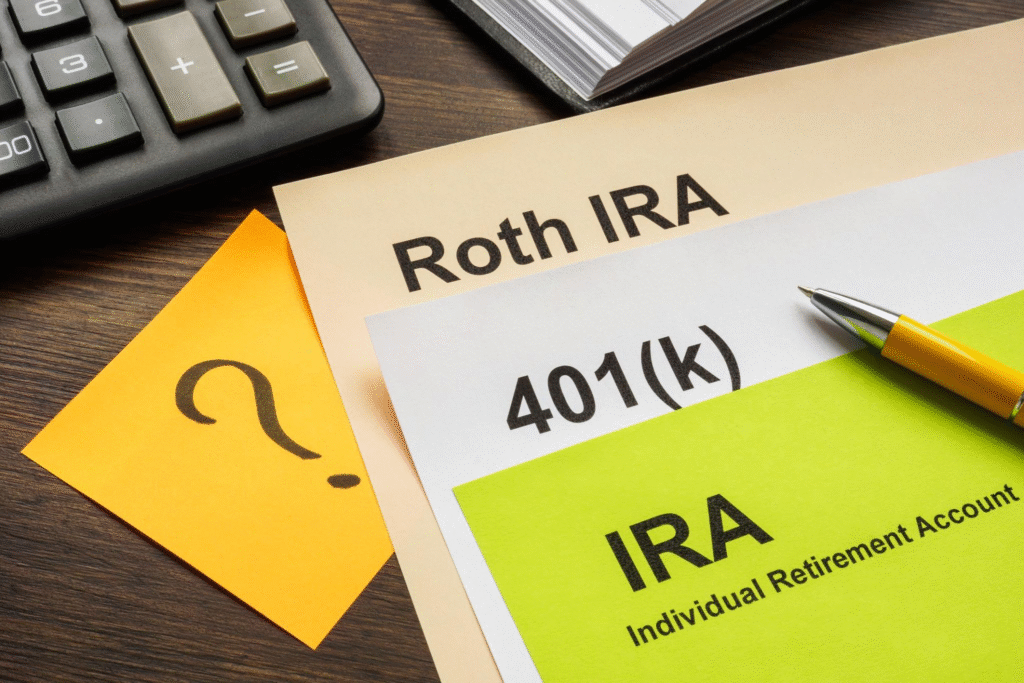
- Tax-deferred accounts (401(k), traditional IRA)
- Tax-free accounts (Roth IRA, Roth 401(k))
- Taxable brokerage investments
Having multiple account types provides flexibility when deciding where to withdraw income from each year.
For example, a retiree facing a higher tax year may draw from Roth accounts to avoid raising taxable income.
Step 2: Consider Strategic Roth Conversions
A Roth conversion involves moving money from a traditional retirement account into a Roth IRA and paying taxes on the converted amount now rather than later.
For many Americans, their early retirement years (before Social Security and RMDs begin) create a lower-income window that can be ideal for conversions.
Example:
A couple retires at 62 but delays Social Security until 70. During those eight years, their taxable income may be relatively low.
In that situation, converting portions of a traditional IRA to a Roth each year could allow them to:
- Fill lower tax brackets
- Reduce future RMDs
- Increase tax-free income later in retirement
However, conversions require careful planning. Large conversions in a single year can increase Medicare premiums or push income into higher tax brackets.
Working with a financial planner or tax professional is often helpful when evaluating this strategy.
Step 3: Plan for Required Minimum Distributions Early
Many retirees underestimate how quickly Required Minimum Distributions (RMDs) can grow.
The IRS calculates RMDs based on account balance and life expectancy. For retirees with large balances, these withdrawals can become substantial.
Consider a simplified example:
A retiree with $1 million in a traditional IRA at age 73 might face an initial RMD of roughly $38,000–$40,000, depending on IRS tables.
If that retiree also receives:
- Social Security
- Pension income
- Investment income
their taxable income could easily exceed expectations.
Common strategies to prepare for RMDs include:
- Gradual Roth conversions before age 73
- Qualified charitable distributions (QCDs) after age 70½
- Strategic withdrawals in earlier retirement years
Planning ahead can prevent future tax surprises.
Step 4: Understand How Social Security Is Taxed
One of the most misunderstood aspects of retirement income is the taxation of Social Security benefits.
Many Americans assume these benefits are tax-free. In reality, up to 85% of Social Security benefits can become taxable depending on total income.
The IRS uses a calculation called “combined income,” which includes:
- Adjusted gross income
- Non-taxable interest
- Half of Social Security benefits
If this combined income crosses certain thresholds, a portion of benefits becomes taxable.
For retirees with multiple income sources, poorly timed withdrawals can unintentionally increase taxes on Social Security.
Strategies sometimes used to manage this include:
- Drawing from Roth accounts in higher-income years
- Coordinating withdrawals before Social Security begins
- Managing capital gains from brokerage accounts

Step 5: Use the “Early Retirement Gap” Wisely
Many Americans retire in their early or mid-60s but delay Social Security benefits until age 67 or 70.
This gap period can present a valuable tax planning opportunity.
During this time, retirees may have lower income because they are no longer earning wages but have not yet started major retirement benefits.
This period may allow for:
- Roth conversions in lower tax brackets
- Strategic withdrawals from tax-deferred accounts
- Capital gains harvesting from brokerage investments
Financial planners sometimes refer to this as the “tax planning window.”
Failing to use this period effectively is one of the most common missed opportunities in retirement planning.
Step 6: Think Carefully About Pension Income Splitting
For married couples, coordinating retirement income between spouses can influence total tax liability.
While the United States does not have formal pension income splitting rules like Canada, couples can still benefit from strategic income coordination.
Examples include:
- Timing Social Security benefits between spouses
- Managing withdrawals from individually owned retirement accounts
- Coordinating IRA distributions to keep the household in a lower tax bracket
Couples should also consider survivor planning.
If one spouse passes away, the surviving spouse typically files as a single taxpayer, which can result in higher tax brackets.
Planning withdrawals and conversions earlier can help reduce this future tax risk.
Step 7: Plan for Medicare Premium Taxes (IRMAA)
Another commonly overlooked issue is the Income-Related Monthly Adjustment Amount (IRMAA).
Medicare premiums increase when income exceeds certain thresholds.
For 2024, higher premiums begin when modified adjusted gross income exceeds:
- $103,000 for individuals
- $206,000 for married couples filing jointly
Large Roth conversions, capital gains, or retirement account withdrawals can push income above these thresholds.
This doesn’t mean such strategies should be avoided. Instead, retirees often plan conversions across multiple years to remain below IRMAA limits when possible.
Step 8: Don’t Ignore State Taxes in Retirement
Federal taxes often receive the most attention, but state tax rules can vary significantly.
Some states do not tax retirement income, while others tax certain types of income differently.
For example:
- Some states exempt Social Security benefits
- Others exclude portions of pension income
- Certain states have no income tax at all
For retirees considering relocation, understanding these rules can be an important part of long-term planning.
Step 9: Coordinate Withdrawal Strategies
One of the most overlooked aspects of retirement planning is how withdrawals are sequenced.
Many retirees simply withdraw from accounts as needed without considering tax efficiency.
A more structured strategy might involve:
- Using taxable accounts first in early retirement
- Taking partial IRA withdrawals before RMD age
- Reserving Roth accounts for later years
This approach can help manage tax brackets over time rather than concentrating taxable income in later retirement.
Step 10: Revisit Your Tax Strategy Every Few Years
Tax planning should not be a one-time decision.
Tax laws evolve, personal circumstances change, and retirement account balances fluctuate.
A periodic review—often every two to three years—can help retirees adjust strategies to match new conditions.
Key moments to revisit tax planning include:
- Retirement date changes
- Major market shifts
- New tax legislation
- Changes in health or family circumstances

Frequently Asked Questions
What age should retirement tax planning start?
Ideally, tax planning begins in your 50s, when retirement account balances are significant but there is still time to adjust strategies before required distributions begin.
Are Roth conversions always a good idea?
Not necessarily. Conversions can be helpful in lower tax years but may be less beneficial if they push income into higher tax brackets.
When do required minimum distributions begin?
Under current U.S. law, RMDs generally begin at age 73 for most retirees.
Are Social Security benefits always taxable?
No. Depending on total income, 0% to 85% of benefits may be taxable.
Is it better to withdraw from taxable accounts first?
In many cases, yes, but the optimal strategy varies depending on income sources, tax brackets, and long-term goals.
How do Roth accounts help in retirement tax planning?
Qualified Roth withdrawals are generally tax-free, providing flexibility when managing taxable income.
Can large withdrawals increase Medicare premiums?
Yes. Higher income can trigger IRMAA surcharges, increasing Medicare Part B and Part D premiums.
How often should retirement tax plans be reviewed?
Every two to three years or whenever there is a significant life or tax law change.
Should retirees work with a financial advisor?
Many retirees find it helpful to consult financial planners or tax professionals, particularly when evaluating Roth conversions and withdrawal strategies.
Do state taxes affect retirement planning?
Yes. State tax rules on retirement income vary widely and can influence relocation decisions.
The Decade That Shapes Your Retirement Taxes
Your 50s and 60s are not just the final stretch before retirement—they are often the most influential years for shaping how retirement income will be taxed.
During this period, Americans still have flexibility to rebalance accounts, adjust withdrawal strategies, and plan around future tax rules. Small adjustments made before retirement can influence income taxes, Social Security taxation, and Medicare costs for decades.
Retirement planning is not only about how much you save—it’s also about how efficiently those savings are used.
Key Lessons to Remember
- Tax diversification across account types can provide flexibility in retirement
- Roth conversions may help reduce future RMDs when used strategically
- Social Security benefits can become taxable depending on income
- Early retirement years often provide valuable tax planning opportunities
- Medicare IRMAA thresholds can increase healthcare costs if income is too high
- Coordinating withdrawals across accounts can improve long-term tax efficiency
- State tax rules may influence retirement relocation decisions
 Robert Weber