

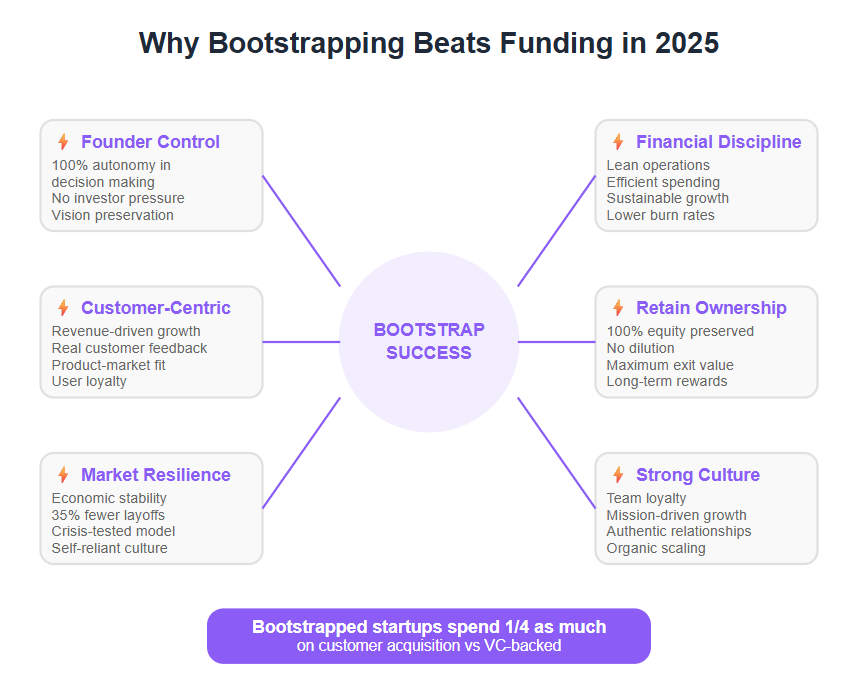
In 2025, the debate between bootstrapping and venture capital (VC) funding is more relevant than ever. While venture capital offers rapid scalability and external expertise, bootstrapping ensures founders retain full control and focus on sustainable profitability. This article explores both options, examines real-life success stories, addresses common questions, and provides actionable insights to help entrepreneurs make informed funding decisions.
Table of Contents
- Introduction: The Evolving Startup Landscape in 2025
- What is Bootstrapping?
- The Venture Capital Route Explained
- Comparing Bootstrapping and Venture Capital
- Real-World Examples of Success
- Factors to Consider Before Choosing Funding
- Frequently Asked Questions (FAQs)
- Practical Takeaways for Founders
- Conclusion: Choosing the Right Path for Your Startup
- Suggested Hashtags for Social Media
Introduction: The Evolving Startup Landscape in 2025 <a name=”introduction”></a>
The startup ecosystem in 2025 is evolving rapidly due to technological advancements, changing investor behaviors, and the rising emphasis on sustainable growth. Founders now face critical decisions about how to fund their ventures, weighing the benefits of retaining control against the allure of rapid growth and external expertise.
With the economic uncertainty and competitive pressures of 2025, the choice between bootstrapping and venture capital is not just about finances—it can define the long-term strategy, culture, and resilience of a startup. This comprehensive guide dives deep into both funding strategies to help entrepreneurs make informed, strategic decisions.
What is Bootstrapping? <a name=”what-is-bootstrapping”></a>
Bootstrapping is the practice of building and growing a business using personal savings, revenue from initial sales, or funds borrowed from friends and family—without taking external investor funding. This approach is rooted in self-reliance and often emphasizes lean operations and profitability from day one.
Advantages of Bootstrapping
- Full Control: Founders retain 100% ownership and decision-making authority. They set the vision, strategy, and culture without interference.
- Profit-Focused: Because every dollar counts, bootstrapped startups often prioritize sustainable growth, efficient operations, and revenue generation early.
- Flexibility: Pivoting business strategies or adjusting product offerings is easier without external stakeholders pressuring for specific outcomes.
- Long-Term Stability: Avoiding debt or equity dilution allows the company to maintain resilience even during market fluctuations.
Challenges of Bootstrapping
- Limited Capital: Growth is restricted by available personal funds and early revenue. This can slow scaling.
- High Risk: Founders are personally financially exposed if the business fails.
- Resource Constraints: Limited funds can hinder hiring, marketing campaigns, research & development, or technology adoption.
- Market Competition Pressure: Competing against VC-backed startups with deep pockets can be challenging.
Example: Many SaaS and tech startups have successfully bootstrapped, growing slowly but profitably before considering external funding or acquisitions.
The Venture Capital Route Explained <a name=”venture-capital-route”></a>
Venture capital (VC) is a funding model where investors provide capital to startups in exchange for equity. This is especially common for businesses with high growth potential that require significant upfront investment to scale quickly.
Advantages of Venture Capital
- Access to Large Capital: VC provides substantial funds for hiring, product development, and marketing, accelerating growth.
- Expert Guidance: Investors often bring expertise, mentorship, and valuable networks that can help startups navigate challenges.
- Rapid Scalability: With ample funds, startups can capture market share quickly and establish competitive dominance.
- Enhanced Credibility: Securing VC funding can signal trustworthiness and growth potential to customers and partners.
Challenges of Venture Capital
- Dilution of Ownership: Founders give up equity, sometimes a significant percentage, reducing control.
- Pressure for Rapid Growth: Investors expect quick returns, often creating high-pressure environments and short-term growth focus.
- Loss of Control: Strategic decisions may require approval from investors, reducing autonomy.
- Exit Pressure: Many VCs push for IPOs or acquisitions, which may not align with the founder’s long-term vision.
Example: High-profile VC-backed companies like Uber and WeWork achieved rapid growth, but founders faced immense pressure and eventual control challenges.
Comparing Bootstrapping and Venture Capital <a name=”comparison”></a>
Here’s a side-by-side look at key factors:
| Aspect | Bootstrapping | Venture Capital |
|---|---|---|
| Ownership | 100% founder-owned | Diluted equity |
| Control | Full autonomy | Shared decision-making |
| Growth Pace | Organic, steady | Rapid, aggressive |
| Financial Risk | High personal financial exposure | Risk shared with investors |
| Profit Focus | Immediate profitability | Long-term capital gains |
| Investor Pressure | None | High expectations for ROI |
| Market Validation | Must self-validate using early customers | Often validated by investor interest |
Key Insights:
- Bootstrapping encourages lean operations, strong financial discipline, and sustainable growth.
- VC funding accelerates market penetration, product development, and brand awareness, but at the cost of autonomy.
- Founders should match their personal goals, business model, and risk appetite with the funding approach.
Real-World Examples of Success <a name=”real-world-examples”></a>
1. Base44
Founded by Maor Shlomo, Base44 is an AI-powered app builder that achieved an $80 million acquisition by Wix in just six months. Shlomo bootstrapped the startup, achieving $1 million ARR three weeks after launch and scaling to over 400,000 users without external funding.
Source: Lenny’s Newsletter
2. SocialPilot
Ahmedabad-based SocialPilot reached a global exit valued at over ₹400 crore (~$50 million). Founded in 2014 without external funding, the company serves over 13,000 businesses worldwide.
Source: Times of India
3. Minfy Technologies
Named the Bootstrap Champ at the ET Startup Awards 2025, Minfy Technologies scaled profitably in cloud and IT services without external funding. Their strategy emphasized low burn rates and high operational agility.
Source: Economic Times
Insights: Real-world examples demonstrate that bootstrapped startups can achieve rapid growth, global reach, and profitable exits, challenging the notion that VC is always required for success.
Factors to Consider Before Choosing Funding <a name=”factors-to-consider”></a>
When evaluating bootstrapping vs. venture capital, founders should ask:
- Business Model Fit: Tech-heavy startups may need VC due to upfront development costs. Service or SaaS startups may bootstrap efficiently.
- Market Potential: Industries with fast growth potential often benefit from VC’s rapid expansion capabilities.
- Personal Goals: Desire for autonomy favors bootstrapping; desire for rapid scaling may favor VC.
- Risk Tolerance: Founders must assess financial exposure and personal comfort with investor accountability.
- Operational Agility: Bootstrapped companies can pivot faster without investor approval.
- Exit Strategy: VC often pushes for an IPO or acquisition, while bootstrapped startups can choose flexible exits.
Frequently Asked Questions (FAQs) <a name=”faqs”></a>
1. What is bootstrapping?
Bootstrapping is starting and growing a business using personal savings or early revenue without external investment. It emphasizes control, lean operations, and sustainable growth.
2. What is venture capital?
Venture capital is investment from external investors in exchange for equity, aimed at accelerating growth and market penetration.
3. Which is better for my startup?
It depends on your business model, growth ambitions, and tolerance for risk. Bootstrapping offers autonomy and immediate profitability; VC offers speed, mentorship, and scalability.
4. Can a bootstrapped startup scale effectively?
Yes. Many bootstrapped startups, such as Base44 and SocialPilot, have achieved global success while remaining profitable.
5. What are the risks of venture capital?
Risks include equity dilution, investor pressure for fast growth, and potential loss of control.
6. Are hybrid funding options available?
Yes, options like SAFE notes, convertible notes, or revenue-based financing allow raising capital without giving up significant equity.
7. How do I attract VC investors?
Demonstrate scalability, strong market demand, a capable team, and solid traction in your niche.
8. Are there tax implications for bootstrapping?
Yes, personal funds invested may be deductible, but consulting a tax professional is recommended.
9. Can I start bootstrapped and seek VC later?
Absolutely. Many startups bootstrap initially and pursue VC funding after validating the market and achieving traction.
10. What are common exit strategies for bootstrapped startups?
Options include mergers, acquisitions, or public offerings, depending on growth trajectory and market conditions.
Practical Takeaways for Founders <a name=”takeaways”></a>
- Focus on Lean Growth: Prioritize revenue generation and efficient operations.
- Validate Early: Test products with early customers to ensure market fit.
- Plan Your Funding Strategy: Decide if bootstrapping, VC, or a hybrid approach aligns with your long-term goals.
- Track Metrics: Monitor cash flow, burn rate, and profitability to make informed decisions.
- Build Relationships: Networking can lead to mentorship, partnerships, or future investment opportunities.
Conclusion: Choosing the Right Path for Your Startup <a name=”conclusion”></a>
In 2025, there is no one-size-fits-all answer to whether bootstrapping or venture capital is the better funding path. Each approach has unique advantages, challenges, and implications for control, growth, and sustainability. Founders must evaluate their business models, personal goals, and market dynamics before deciding.
Bootstrapping can yield autonomy, profitability, and sustainable growth, while venture capital can accelerate scaling, provide mentorship, and enhance market credibility. By understanding both approaches, entrepreneurs can choose a path that aligns with their vision and long-term success.
 Julia
Julia