

Major U.S. banks are steadily integrating digital assets into their long-term strategies through custody services, tokenized deposits, blockchain-based settlement, and partnerships with fintech firms. Rather than replacing traditional banking, digital assets are modernizing infrastructure and expanding client offerings. This article explains how banks are approaching crypto, regulatory considerations, and what these developments mean for investors and customers.
The Shift From Skepticism to Strategic Integration
Just a few years ago, many large U.S. banks approached digital assets cautiously, citing volatility and regulatory uncertainty. Today, the conversation has matured. Instead of asking whether digital assets belong in finance, major institutions are evaluating how blockchain infrastructure can improve efficiency, expand product offerings, and meet client demand.
Americans frequently search for answers to questions like:
- Are U.S. banks investing in crypto?
- Can I buy digital assets through my bank?
- Are banks creating their own digital currencies?
The reality is more nuanced than headlines suggest. Major banks are not transforming into crypto exchanges. Instead, they are incorporating digital asset capabilities into existing frameworks, often in measured and compliance-focused ways.
Why Banks Are Paying Attention to Digital Assets
Banks operate within strict regulatory frameworks, and they rarely pursue trends without long-term strategic analysis. Several forces are driving digital asset integration:
- Growing institutional client demand
- Competitive pressure from fintech firms
- Efficiency gains in settlement and cross-border payments
- The rise of tokenization and digital securities
- Regulatory clarity compared to previous years
According to industry research from large consulting firms and financial institutions, global tokenized asset markets could represent trillions of dollars in value over the next decade. While projections vary, banks recognize that ignoring blockchain infrastructure could mean missing structural shifts in capital markets.
Digital Asset Custody: The Entry Point for Banks
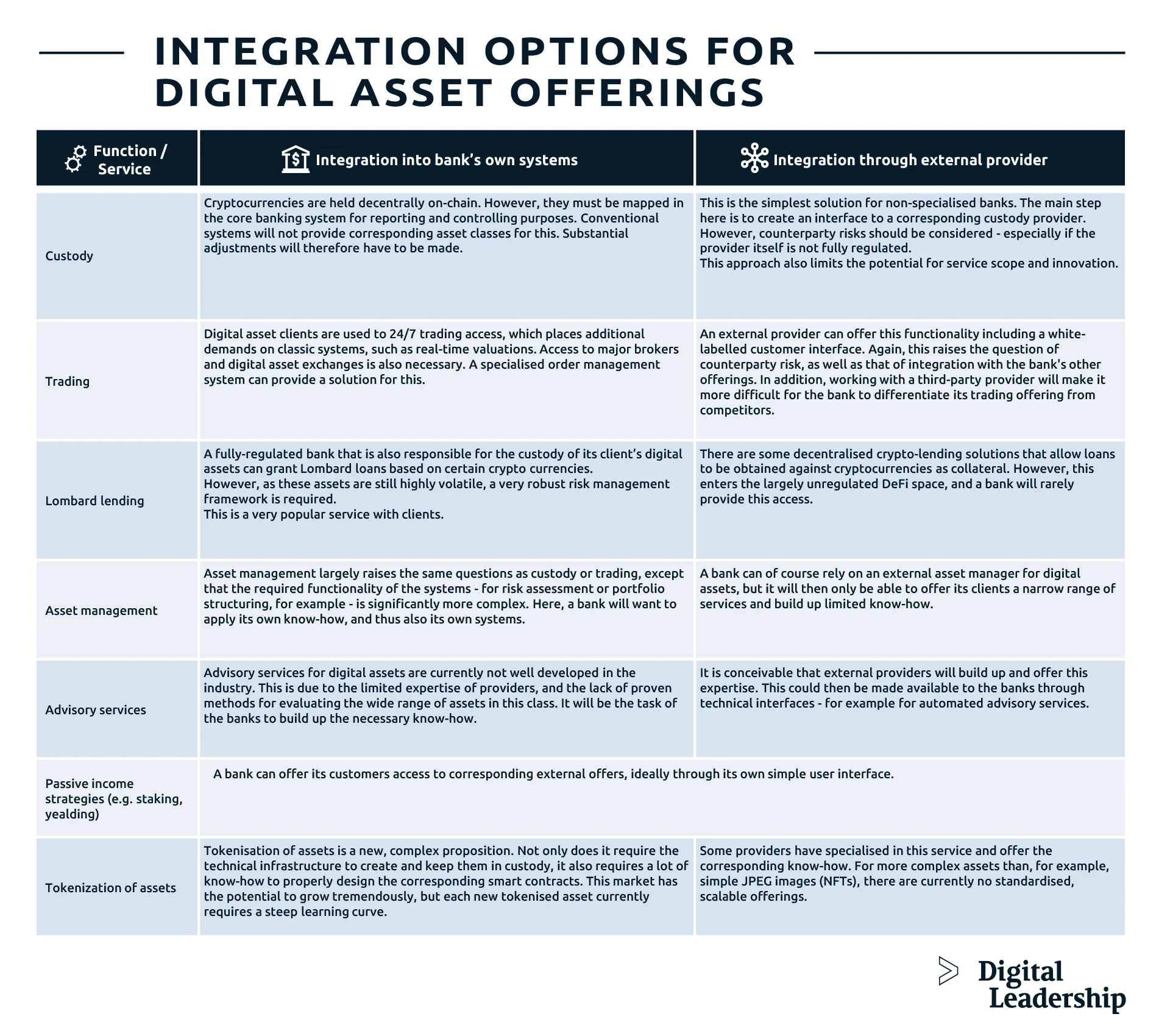
One of the most common ways banks have entered the digital asset space is through custody services. Institutional investors—such as hedge funds, asset managers, and pension funds—require secure storage before allocating capital to digital assets.
Banks already possess:
- Compliance systems
- Risk management frameworks
- Institutional trust
- Insurance relationships
By offering digital asset custody, banks extend familiar services into new asset classes.
In practice, this means cold storage solutions, multi-signature authorization systems, and strict internal controls. For example, large custodial banks have developed segregated digital asset vaults designed to meet regulatory and fiduciary standards.
For clients, this reduces operational risk compared to self-custody or lightly regulated platforms.
Tokenized Deposits and On-Chain Settlement
Beyond custody, some banks are experimenting with tokenized deposits—digital representations of traditional bank deposits recorded on blockchain networks.
Unlike stablecoins issued by private companies, tokenized deposits remain liabilities of regulated banks. This distinction matters because deposits are subject to existing banking supervision and, in many cases, FDIC insurance protections.
Tokenized deposits allow:
- Faster internal settlement
- 24/7 transaction capabilities
- Programmable payments
- Improved reconciliation processes
For corporate treasury teams managing large-scale transactions, real-time settlement can significantly reduce counterparty risk and operational friction.
Cross-Border Payments and Efficiency Gains
International payments have historically been slow and expensive due to intermediary banks and legacy infrastructure. Blockchain-based settlement systems offer potential efficiency improvements.
Banks are testing digital asset rails to:
- Reduce settlement times from days to minutes
- Lower transaction costs
- Increase transparency in payment tracking
These improvements are particularly relevant for multinational corporations, supply chain operations, and remittance services.
Importantly, banks are not abandoning SWIFT or traditional rails overnight. Instead, they are layering blockchain technology where it offers measurable efficiency gains.
Partnerships With Fintech and Technology Firms
Rather than building every solution internally, many banks collaborate with fintech firms and blockchain infrastructure providers.
These partnerships allow banks to:
- Accelerate innovation
- Reduce development risk
- Access specialized blockchain expertise
- Maintain regulatory compliance
For example, some banks integrate blockchain analytics tools to enhance anti-money laundering (AML) compliance in digital asset transactions.
Such collaboration reflects a broader trend: traditional finance and fintech are converging rather than competing outright.
Regulatory Considerations: The Guardrails Shaping Strategy
Banks operate under intense regulatory scrutiny. Federal agencies including the Federal Reserve, Office of the Comptroller of the Currency (OCC), and Federal Deposit Insurance Corporation (FDIC) issue guidance regarding digital asset exposure.
Banks must evaluate:
- Capital treatment of digital assets
- Liquidity requirements
- Cybersecurity safeguards
- Consumer protection standards
- Stablecoin reserve implications
Recent regulatory communications have emphasized risk management rather than prohibition. This has encouraged banks to proceed cautiously but not retreat entirely.
Regulatory clarity plays a decisive role. When ETF approvals or stablecoin guidance becomes clearer, banks can expand services with greater confidence.
Are Banks Buying Crypto for Their Own Balance Sheets?
Most major U.S. banks are not holding significant speculative crypto positions on their balance sheets. Instead, they focus on client-facing services and infrastructure development.
However, banks may:
- Provide access to crypto-linked ETFs
- Facilitate trading through brokerage arms
- Offer research coverage on digital assets
- Support tokenization pilots
This distinction is important. Banks prioritize stability and shareholder accountability. Their digital asset integration strategies emphasize service expansion over speculative exposure.
The Role of Institutional Demand
Institutional investors have significantly influenced banks’ digital asset strategies. When pension funds, endowments, and asset managers begin exploring crypto exposure, banks must respond with secure and compliant solutions.
Institutions typically require:
- Audited custody systems
- Legal clarity on asset classification
- Insurance coverage
- Robust cybersecurity frameworks
Banks are uniquely positioned to provide these services at scale.
What This Means for Everyday Customers
Retail banking customers may notice incremental changes rather than dramatic shifts.
Possible consumer-facing developments include:
- Crypto access through bank brokerage platforms
- Integrated digital asset reporting in account dashboards
- Faster settlement of certain transactions
- Expanded financial education resources
However, traditional checking accounts and debit cards are not disappearing. Digital assets represent an extension—not a replacement—of conventional banking services.
Risks Banks Must Manage
Despite growing integration, banks face measurable risks:
- Cybersecurity vulnerabilities
- Reputational risk from volatile markets
- Regulatory enforcement exposure
- Liquidity stress in extreme scenarios
Risk management frameworks remain central. Large banks invest heavily in cybersecurity and internal controls before expanding digital asset offerings.
Frequently Asked Questions
1. Are major U.S. banks offering crypto services?
Yes, many offer custody, brokerage access, or digital asset research services, though offerings vary by institution.
2. Can I buy Bitcoin directly through my bank?
Some banks provide access through affiliated brokerage services or ETFs rather than direct token purchases.
3. Are bank-issued stablecoins available?
Most U.S. banks are exploring tokenized deposits rather than issuing retail-facing stablecoins.
4. Is my money safe if banks use blockchain?
Traditional deposits remain subject to banking regulations and, where applicable, FDIC protections.
5. Why are banks cautious about crypto?
Regulatory uncertainty, volatility, and cybersecurity risks require careful oversight.
6. Are banks replacing SWIFT with blockchain?
No. Blockchain systems are being tested to complement, not fully replace, existing payment networks.
7. Do banks hold crypto on their balance sheets?
Generally, large banks focus on infrastructure and client services rather than speculative holdings.
8. How does digital asset custody work at banks?
Assets are typically stored in secure, segregated systems with multi-layered access controls.
9. Will banks launch their own digital currencies?
Some are exploring tokenized deposits; a U.S. central bank digital currency would require federal authorization.
10. What’s the long-term goal for banks?
To modernize financial infrastructure while maintaining regulatory compliance and risk discipline.
Banking’s Digital Evolution: Infrastructure Over Hype
The integration of digital assets into major U.S. banks is less about speculative enthusiasm and more about infrastructure modernization. Blockchain technology offers efficiency gains, enhanced settlement mechanisms, and new client services. Yet banks are proceeding deliberately, guided by regulatory frameworks and risk management priorities.
The long-term strategy appears clear: incorporate digital asset capabilities where they improve operational performance, strengthen client relationships, and align with regulatory expectations.
Traditional banking is not disappearing. It is evolving.
Strategic Indicators Worth Monitoring
- Expansion of digital asset custody offerings
- Growth in tokenized deposit pilots
- Regulatory updates from federal banking agencies
- Institutional capital allocation trends
- Increased integration between fintech platforms and banks
 Julia
Julia