

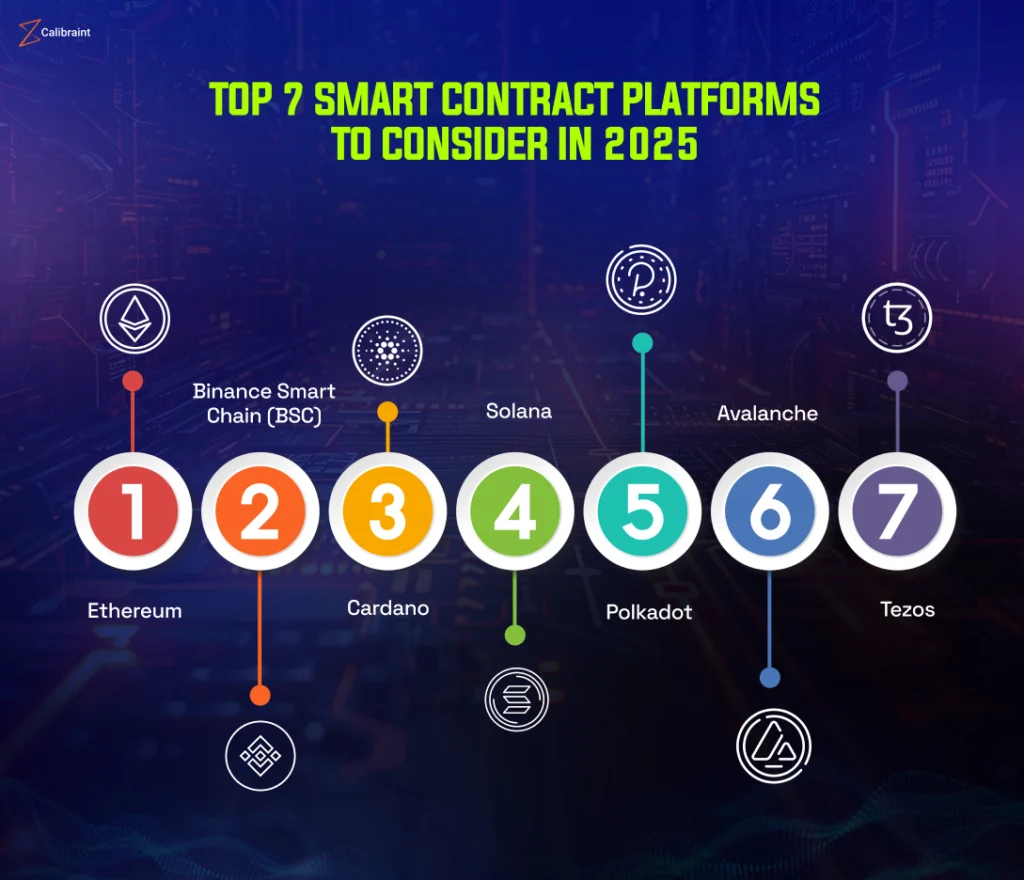
Ethereum remains the leading smart contract platform in 2025, but faces growing competition from Solana, BNB Chain, Cardano, and Avalanche. Explore Ethereum’s strengths, weaknesses, real-world use cases, and future roadmap to decide if it’s still the best blockchain for your project.
Ethereum’s Big Question in 2025
When Ethereum launched in 2015, it transformed blockchain technology by making smart contracts programmable and accessible to developers. It was a breakthrough moment—the first widely adopted blockchain where developers could write code, deploy decentralized applications (dApps), and enable entire new financial systems like DeFi and NFTs.
But fast forward to 2025, and the landscape is far more competitive. Platforms like Solana, Avalanche, Cardano, and Binance Smart Chain (BNB Chain) all promise faster speeds, cheaper transactions, or more specialized features. Ethereum has upgraded significantly—switching to proof of stake (The Merge), rolling out scalability improvements like EIP-4844 (proto-danksharding), and expanding its Layer 2 ecosystem—but the question remains: Is Ethereum still the best smart contract platform?
In this article, we’ll unpack Ethereum’s current position, strengths, weaknesses, competitors, and real-world use cases. We’ll also answer the most pressing questions people are asking right now, giving you practical advice on whether Ethereum is the right platform for your project in 2025.
What “Best Smart Contract Platform” Really Means
Before deciding whether Ethereum is still the best, we need to define what “best” even means. Different users—developers, investors, enterprises, or casual crypto users—care about different priorities.
Some of the main criteria include:
- Security & Decentralization – Is the network resistant to attacks, manipulation, or censorship?
- Scalability & Throughput – How many transactions per second (TPS) can the platform handle? How quickly do they finalize?
- Cost Efficiency – Are transaction (“gas”) fees affordable for users, especially for frequent or micro-transactions?
- Ecosystem & Developer Tools – Does the chain have strong developer support, frameworks, and community activity?
- Interoperability – Can the chain connect with other blockchains easily?
- Sustainability – What’s the energy footprint, and is it future-proof?
- Adoption & Liquidity – How much total value is locked (TVL) in its DeFi ecosystem? How many users and projects are active?
Ethereum doesn’t win on all of these criteria, but it still dominates several, which explains why it has retained its crown.
Ethereum’s Strengths in 2025
Ethereum has several advantages that remain unmatched, even in the face of fierce competition.
1. Market Share and Developer Adoption
Ethereum commands more than 50% of the smart contract market share worldwide. It has around 3,200+ monthly active developers, far surpassing Cardano (~720) or Solana. This developer dominance translates into better tooling, more audited code, and a richer ecosystem of decentralized applications.
📊 Fun fact: More than 4.3 million smart contracts were deployed on Ethereum in the first half of 2025, a 32% year-over-year growth. This surge shows that developers are still committed to building on Ethereum despite newer alternatives.
2. A Continuous Upgrade Path
Ethereum isn’t standing still. Major upgrades have addressed scalability and cost:
- The Merge (2022): Transitioned from Proof of Work to Proof of Stake, cutting energy consumption by over 99%.
- EIP-4844 (2024): Introduced proto-danksharding to reduce data costs for rollups, dramatically lowering Layer 2 transaction fees.
- Sharding (future roadmap): Will further improve throughput by splitting Ethereum into parallel shards.
3. Unmatched Ecosystem
Ethereum’s ecosystem is the most mature:
- DeFi giants: Uniswap, Aave, MakerDAO, Curve.
- NFT platforms: OpenSea, Blur, Foundation, SuperRare.
- Infrastructure tools: Hardhat, Foundry, Remix, MetaMask.
No other blockchain can claim this breadth of applications, liquidity, and user familiarity.
4. Security and Decentralization
With thousands of validators and billions of dollars staked, Ethereum is one of the most secure Proof-of-Stake blockchains in existence. Competitors often trade decentralization for performance, but Ethereum’s validator set ensures robust resilience against attacks.
5. Layer 2 Expansion
Rather than scaling only at Layer 1, Ethereum’s rollup-centric roadmap allows projects to deploy on Layer 2 networks like Optimism, Arbitrum, and zkSync. These inherit Ethereum’s security while offering faster and cheaper transactions.
Ethereum’s Weaknesses in 2025
Ethereum isn’t perfect, and these weaknesses fuel competition.
- High Gas Fees During Congestion – Despite improvements, mainnet fees can still spike to several dollars per transaction. Competing blockchains often boast fees measured in fractions of a cent.
- Slower Throughput vs Newcomers – Even with rollups, Ethereum is slower than Solana’s 65,000 TPS or Avalanche’s sub-second finality.
- Complex User Experience – Bridging between Ethereum and L2s is often confusing for mainstream users. Delays, fees, and risks can turn people away.
- Upgrade Complexity – Ethereum’s roadmap is ambitious but slow. Coordinating upgrades across the decentralized ecosystem takes time and consensus.
- Competition in Niche Use Cases – For gaming, micro-transactions, or specific enterprise solutions, other chains may be a better fit.
Competitors: Who Challenges Ethereum?
Let’s look at how the main competitors stack up.
Solana
- Strengths: Ultra-fast TPS, near-zero fees, growing NFT and gaming ecosystem.
- Weaknesses: Centralization risks, network outages, less security history.
BNB Chain
- Strengths: Cheap transactions, strong retail adoption, massive exchange support.
- Weaknesses: Regulatory concerns, weaker decentralization.
Cardano
- Strengths: Academic rigor, formal verification, eco-friendly.
- Weaknesses: Slower development pace, fewer apps deployed.
Avalanche
- Strengths: Subnets allow custom blockchains, fast finality, scalable.
- Weaknesses: Smaller ecosystem, less liquidity, adoption challenges.
Polkadot & Cosmos
- Strengths: Interoperability and modular blockchain design.
- Weaknesses: Complexity, smaller developer community, fragmented adoption.
Real-World Examples
- DeFi Trading: Ethereum powers Uniswap, the world’s largest DEX. But traders seeking cheaper swaps often use PancakeSwap (BNB) or Raydium (Solana).
- NFTs: Ethereum still hosts the biggest, most valuable NFT collections like Bored Ape Yacht Club. Yet Solana attracts creators who need low-cost minting.
- Gaming: High-volume blockchain games often choose Solana or Polygon for performance.
- Payments: For micro-payments or remittances, BNB and Stellar are more practical than Ethereum mainnet.
- Enterprise Solutions: Companies looking for robust, battle-tested platforms often stick with Ethereum or build on its sidechains.
FAQs: Answering Trending Questions
1. Is Ethereum cheaper than Solana or BNB in 2025?
No. Solana and BNB usually win on cost. However, Ethereum Layer 2s narrow the gap, making Ethereum competitive for most dApps.
2. Is Proof of Stake secure?
Yes. Ethereum’s PoS system is backed by billions in staked ETH and thousands of validators. It’s widely regarded as secure, though different from Bitcoin’s PoW.
3. How many developers use Ethereum?
Around 3,200+ monthly active developers, far ahead of most rivals. This makes Ethereum the most attractive ecosystem for new projects.
4. Does Ethereum’s roadmap solve scalability?
Partially. EIP-4844 reduces L2 fees drastically. Sharding will expand throughput further. But Ethereum likely won’t reach Solana-like speeds soon.
5. What are risks of newer blockchains?
Centralization, weaker security, smaller liquidity pools, and reliance on untested bridges.
6. Should I use Ethereum L2s or a new L1?
For most projects, L2s like Arbitrum or zkSync offer the best of both worlds: Ethereum’s security with lower fees.
7. Which blockchain is best for NFTs?
Ethereum dominates high-value NFTs. Solana and Flow are better for low-cost, high-volume projects.
8. How energy-efficient is Ethereum now?
Extremely efficient post-Merge. Energy consumption dropped by 99% compared to Proof of Work.
9. Will Ethereum be dethroned?
Unlikely in the short term. The future is multi-chain, but Ethereum will remain a central hub.
10. How do I choose the right platform for my dApp?
Evaluate: scale, cost, security needs, UX requirements, liquidity, and regulatory considerations.
Practical Takeaways for Developers and Businesses
- If security and decentralization are your top priorities → Choose Ethereum mainnet or L2.
- If you need ultra-low fees and speed for gaming or micro-transactions → Consider Solana or Polygon.
- If you’re targeting DeFi with serious liquidity → Ethereum still rules.
- If compliance and enterprise stability matter → Ethereum or Cardano may be safer.
- Always budget for audits, gas testing, and UX research before deploying.
Conclusion: Is Ethereum Still the Best?
Yes—Ethereum is still the best overall smart contract platform in 2025, but not for every use case. It dominates in security, liquidity, developer activity, and prestige. Its upgrades and Layer 2 ecosystem ensure it remains relevant and innovative.
However, for apps demanding extremely cheap and fast transactions, platforms like Solana or Avalanche may be more suitable. The smart contract world is becoming multi-chain, and the best choice depends on your project’s goals.
If you’re building in 2025, Ethereum + Layer 2 is still the most reliable and future-proof path.
 Julia
Julia