


Summary
Income allocation plays an increasingly important role in modern tax planning for couples. By understanding how income is distributed between spouses—through salaries, investments, retirement accounts, and business ownership—couples can better manage tax brackets, deductions, and long-term financial goals. Thoughtful allocation doesn’t eliminate taxes, but it can improve efficiency, strengthen financial stability, and support more strategic household planning.
Why Income Allocation Matters for Couples Today
For many American households, tax planning no longer revolves solely around filing returns each April. Increasingly, it involves year-round financial decisions—how income is earned, where investments are held, and how earnings are distributed between partners.
Income allocation refers to how taxable income is divided between spouses within a household. While married couples filing jointly report combined income on their federal tax return, the way income is generated and assigned between partners can still influence tax outcomes.
Modern couples often have complex financial lives:
- Dual incomes
- Investment portfolios
- Side businesses or freelance income
- Stock compensation
- Retirement accounts
- Rental property or passive income
Because U.S. federal tax rates are progressive, where income sits—whether with one spouse or divided between both—can affect total household taxes.
Financial planners frequently review income allocation strategies as part of broader tax planning discussions, especially when couples experience:
- Significant differences in income levels
- Business ownership
- Investment gains
- Changes in career or retirement timing
According to the Tax Foundation, progressive tax brackets mean marginal tax rates increase as income rises, which can create opportunities for tax efficiency when income sources are strategically structured.
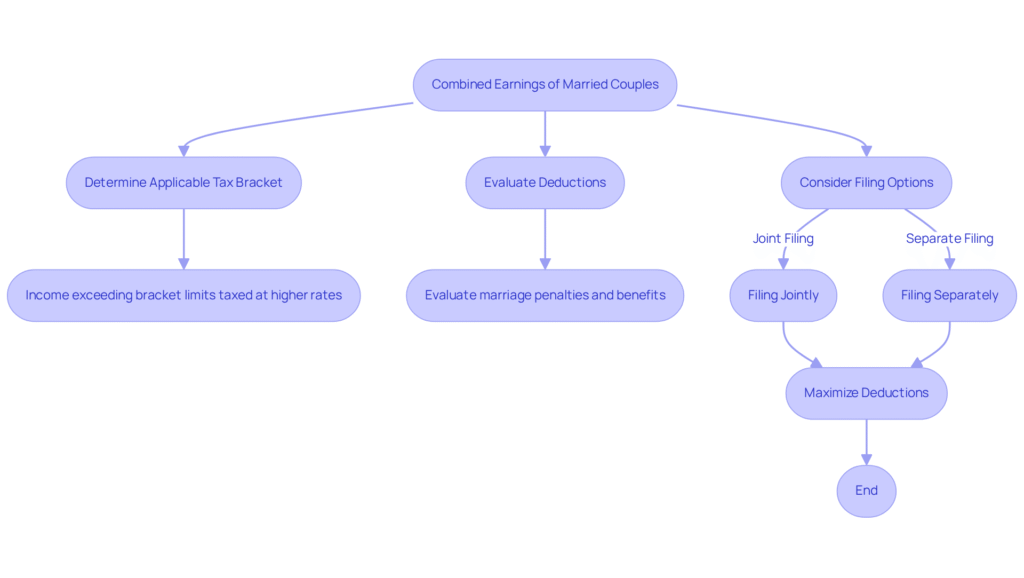
Understanding the Basics of Income Allocation
Income allocation doesn’t mean shifting wages arbitrarily between spouses. U.S. tax law requires that income generally be taxed to the person who earns it. However, couples still have legitimate ways to structure financial activity that influence how income appears across both partners.
Examples include:
- Investment ownership
- Retirement account contributions
- Business compensation structure
- Timing of income recognition
- Use of family partnerships in certain situations
A simple example illustrates the concept.
Imagine a married couple:
- One spouse earns $220,000 as a physician.
- The other spouse earns $40,000 from part-time consulting.
If investments generating dividend income are held entirely in the higher-earning spouse’s account, that income may be taxed at a higher marginal rate. In some cases, financial advisors recommend placing certain investments under the lower-earning spouse’s ownership, depending on the couple’s overall strategy.
The goal isn’t to “avoid taxes,” but to manage them thoughtfully within the rules.
How U.S. Tax Brackets Affect Household Planning
The U.S. tax system uses progressive brackets. For married couples filing jointly in recent years, income moves through several marginal tax levels before reaching the highest rates.
Because of this structure, how income is distributed across spouses can influence:
- marginal tax exposure
- eligibility for deductions
- phase-outs for tax credits
- Medicare surtaxes on investment income
Couples may also encounter thresholds tied to income levels, such as:
- Net Investment Income Tax (NIIT)
- Medicare surtax
- Child tax credit phase-outs
- Education tax credit limits
Strategic income allocation can sometimes help households remain below certain thresholds or better utilize deductions.
However, decisions should always consider the couple’s broader financial plan—not just taxes for a single year.

Common Income Allocation Approaches Used by Couples
Financial advisors often review several allocation strategies when working with married clients. These strategies depend on individual circumstances, employment structures, and investment portfolios.
Some commonly discussed approaches include:
Investment Ownership Structuring
Couples sometimes review how investment assets are titled.
Possible considerations include:
- Holding income-generating investments in the lower-earning spouse’s account
- Balancing taxable investment accounts between spouses
- Reviewing dividend-producing assets
Ownership structure can affect how dividends, interest, and capital gains are reported.
Retirement Contribution Optimization
Retirement accounts also influence income allocation.
For example:
- A higher-earning spouse may maximize 401(k) contributions
- A lower-earning spouse may contribute to a spousal IRA
- Roth vs. traditional account decisions can affect future tax distribution
These decisions influence both current-year taxes and retirement-phase taxation.
Business Compensation Planning
For couples involved in a family business or closely held company, compensation structure may matter.
Possible approaches include:
- Paying reasonable salaries to both working spouses
- Dividing ownership shares in certain partnership structures
- Structuring distributions appropriately
However, the IRS requires that compensation reflect actual work performed.
Timing of Income Events
Income allocation also interacts with timing decisions, such as:
- Exercising stock options
- Selling investments
- Realizing capital gains
- Recognizing consulting or freelance income
Coordinating these events with a spouse’s income levels in a given year can sometimes improve tax outcomes.
Real-World Example: Dual-Income Household
Consider a couple in Seattle:
Spouse A
- Software engineer earning $180,000
- Receives stock compensation
Spouse B
- Freelance designer earning $70,000
- Has flexibility in invoicing schedules
Their financial advisor reviews several income allocation opportunities:
- Some investment income is held in Spouse B’s brokerage account.
- Retirement contributions are maximized for both partners.
- A large stock option exercise is spread across two tax years.
Individually, none of these decisions dramatically changes the tax picture. But collectively they help stabilize the household’s marginal tax exposure.
This approach reflects the broader philosophy of modern tax planning: incremental improvements rather than dramatic maneuvers.
Income Allocation and Investment Strategy
Income allocation often intersects with portfolio planning.
Couples sometimes coordinate the following:
- Dividend-producing assets
- Tax-efficient index funds
- Municipal bond holdings
- Tax-loss harvesting strategies
For example, municipal bonds may produce tax-exempt interest, which could be beneficial for higher-income households.
Meanwhile, lower-earning spouses may hold certain taxable investments if the couple’s strategy supports it.
Again, decisions must align with investment goals—not only tax considerations.
When Income Allocation May Have Limited Impact
Despite its importance, income allocation is not always a major factor.
For example, couples filing jointly already benefit from broader tax brackets compared with single filers. In many households, shifting income between spouses may not meaningfully change the total tax bill.
Income allocation tends to matter most when:
- One spouse earns significantly more than the other
- Investment income is substantial
- A business is involved
- Large capital gains occur
- Equity compensation is part of the pay structure
For couples with similar incomes and straightforward financial profiles, tax outcomes may be largely unaffected by allocation strategies.
Compliance and IRS Considerations
Income allocation must always comply with U.S. tax rules.
Important guidelines include:
- Income must be taxed to the person who earns it
- Transfers designed solely to avoid tax liability can raise scrutiny
- Business compensation must reflect actual services performed
- Investment ownership must be legitimate
The IRS closely reviews arrangements that appear to shift income without economic substance.
Couples should consult qualified tax professionals when implementing structural changes involving:
- family partnerships
- business ownership transfers
- trusts or estate planning vehicles
Professional advice helps ensure strategies remain compliant and sustainable.
Coordinating Income Allocation With Long-Term Financial Goals
Effective tax planning looks beyond one filing season.
Income allocation strategies should support broader household objectives, including:
- retirement savings
- college planning
- debt reduction
- investment growth
- estate planning
For example, allocating retirement savings between spouses may improve long-term flexibility in retirement withdrawals.
Similarly, diversifying investment ownership can support estate planning and beneficiary strategies later in life.
In practice, income allocation is best viewed as one tool within a comprehensive financial plan.

Frequently Asked Questions
What is income allocation in tax planning?
Income allocation refers to how taxable income is distributed between spouses within a household through wages, investments, business earnings, and other financial sources.
Can couples legally shift income between spouses?
Income generally must be taxed to the person who earns it. However, investment ownership, retirement contributions, and business structures can influence how income appears between spouses.
Does income allocation reduce taxes for married couples?
In some situations it can improve tax efficiency, particularly when spouses have significantly different income levels.
Does filing jointly eliminate the need for income allocation planning?
No. While joint filing combines income, how that income is generated can still affect deductions, credits, and investment taxation.
Are there risks involved in income allocation strategies?
Improper arrangements—such as assigning income to someone who did not earn it—can raise IRS compliance concerns.
Do financial advisors commonly discuss income allocation?
Yes. It is frequently reviewed as part of broader tax planning, investment strategy, and retirement planning.
How do retirement accounts affect income allocation?
Contributions to retirement accounts can shift taxable income levels and influence long-term tax exposure.
Does income allocation affect capital gains taxes?
Potentially. Investment ownership determines who reports gains, which may interact with tax brackets and surtaxes.
Is income allocation useful for small business owners?
Often yes, especially when both spouses work in the business and compensation structures are flexible.
Should couples review income allocation every year?
Yes. Changes in income, investments, or tax law can affect how effective a particular strategy may be.
Designing a Balanced Household Tax Strategy
Income allocation is rarely a standalone tactic. Instead, it functions as part of a broader financial planning conversation that considers income patterns, investments, retirement goals, and life changes.
For couples navigating increasingly complex financial lives—dual careers, equity compensation, entrepreneurship—understanding how income flows through the household can improve both tax awareness and long-term planning clarity.
Thoughtful coordination between partners, combined with professional guidance, helps ensure that financial decisions reflect both tax efficiency and shared goals.
Key Insights at a Glance
- Income allocation examines how household income is distributed between spouses
- Strategic allocation may influence marginal tax exposure and deduction eligibility
- Investment ownership often plays a role in income distribution
- Retirement accounts help shape both current and future tax outcomes
- Business-owning couples may have more flexibility in structuring income
- Compliance with IRS rules is essential when implementing allocation strategies
- Income allocation works best when integrated into a broader financial plan
 Robert Weber