

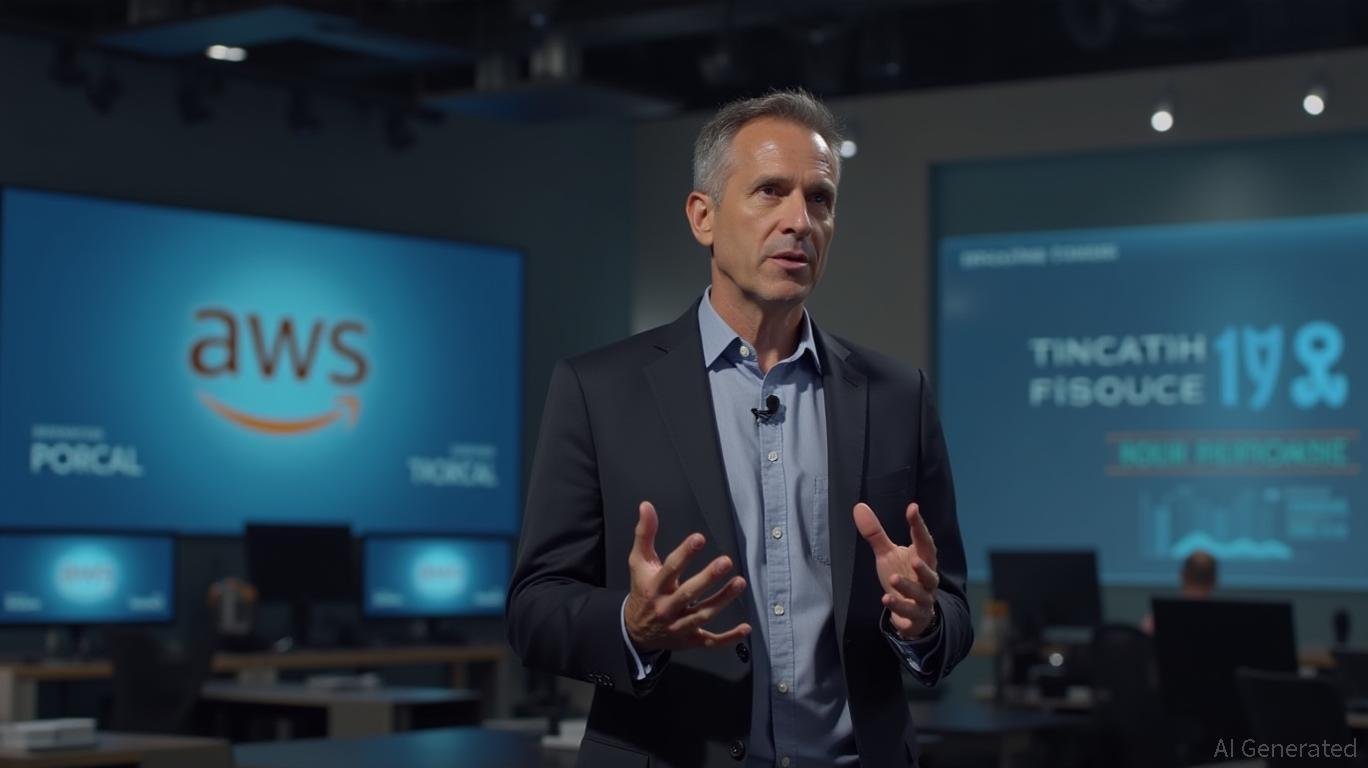
Amazon’s (AMZN) AWS is still a dominant player in the cloud wars, but its slower growth has some investors sitting on the sidelines.
“We’re in the very early stages, but there is such enormous promise in the technology,” Amazon Web Services (AWS) CEO Matt Garman said on Yahoo Finance’s Opening Bid.
Garman added that AWS is still in the early stages of “building the building blocks that we think startups, enterprises, and government agencies are really going to want to use to build both AI applications as well as agentic workflows.”
Amazon stock has gained 4.5% in 2025, underperforming the S&P 500’s (^GSPC) 12% gain.
AWS remains the company’s profit engine and a key driver of its valuation, but investors are debating whether it can keep pace with Microsoft (MSFT) Azure’s growth, which surged last year on the back of its OpenAI (OPAI.PVT) partnership.
In Q2, AWS revenue jumped 17.5% year over year to $30.9 billion, beating estimates of $30.8 billion, according to Bloomberg data. Azure’s revenue soared 39% to $29.9 billion, above expectations of $28.92 billion. Meanwhile, Google (GOOG) Cloud grew 32% to $13.6 billion, surpassing estimates of $13.14 billion.
Morgan Stanley’s Brian Nowak sees reason for optimism. In a note to clients, he highlighted AWS’s partnership with Anthropic (ANTH), including strong demand for generative AI and traditional workloads as potential growth drivers.
“Upcoming data center capacity growth could translate into 20%+ AWS revenue growth in ‘26,” Nowak wrote, adding that new capacity could lift revenue growth beyond the mid-teens pace AWS has seen recently.
He added that “in order for these workloads and revenue to flow, AWS still has to work through capacity constraints,” including “data center builds, delivery of chips, racks, cables, [and] power.” The firm’s analysis suggests the company is successfully working through data center buildout bottlenecks.
Nowak raised his price target on Amazon to $300, with a bull case of $350.
Still, challenges remain for AWS, as expectations rise along with higher capital expenditures, which is set to jump sharply in 2025 and 2026. Garman framed growth as more than just money, saying, “It’s not just about the investment, which is very large, but it’s also about that innovation that comes with it.”
Some analysts warn that AWS faces capacity constraints, rising costs, and growing competition from Microsoft Azure, Google Cloud, and Oracle (ORCL). Winning depends on how well providers combine specialized hardware, partnerships, and software. For AWS, it remains to be seen whether its investments can drive unique AI offerings that keep customers locked in.
Garman pointed to Amazon’s investment in designing custom AI chips as an example of its innovation. The company is looking at how to offer “the very best in AI capabilities so that when you’re actually a customer [who] goes and builds an application, they can embed AI as a core part of the thing that they’re building.”
“And we think that that combination of AI plus and enterprise data is really what’s going to give a lot of our customers the value that they’re looking for,” he said.
Nowak said “AWS’s demand backlog remains strong … which we view as a positive signal of faster AWS revenue growth ahead.”
Maxim Group analyst Tom Forte and RBC Capital analyst Brad Erickson previously told Yahoo Finance that another issue may be timing, as many customers are still experimenting with AI tools rather than deploying them at scale. That suggests that demand is building but not yet breaking out. Startup clients add another layer of volatility, Forte noted, as their spending often rises and falls with funding cycles.
 Robert Weber