

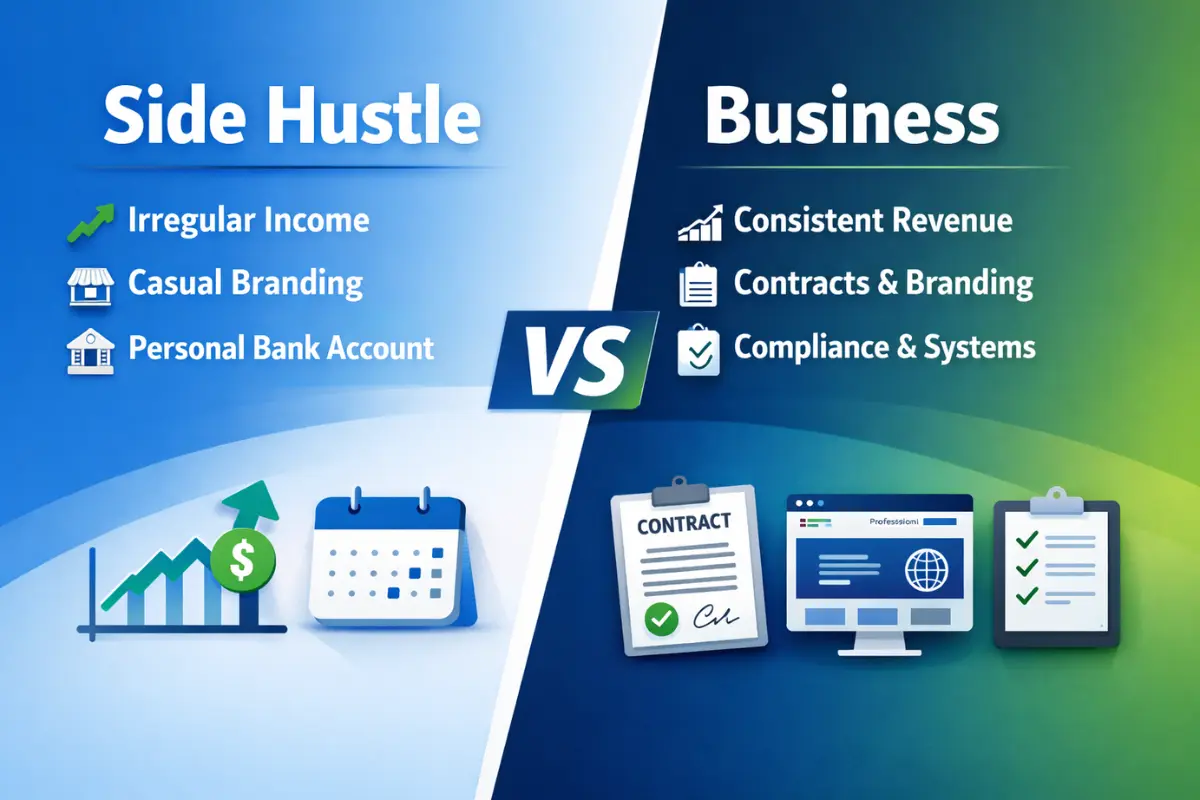
Many Americans begin earning extra income through side hustles, but turning that activity into a structured business requires significant changes. Legal registration, financial systems, operational processes, and strategic planning become essential. This guide explains what actually changes when a side hustle evolves into a formal business, including taxes, hiring, scaling operations, and long-term decision-making.
Why So Many Side Hustles Are Becoming Real Businesses
Side hustles have become a common part of the American economy. What often starts as freelance work, online selling, consulting, or digital services can evolve into a full-scale company.
According to the U.S. Census Bureau, millions of new business applications are filed annually in the United States, many originating from individuals who first operated informally.
The growth of digital marketplaces, flexible work, and creator economies has made it easier than ever to test business ideas with minimal upfront investment. However, once revenue grows or client demand increases, the limitations of operating informally become clear.
At that point, founders often ask practical questions:
- Do I need to register a business entity?
- How do taxes change?
- When should I open a business bank account?
- What systems are needed to handle growth?
The transition from side hustle to structured business is less about scale and more about structure.
The First Major Shift: Legal Structure
One of the clearest differences between a side hustle and a formal business is legal structure.
Many side hustlers initially operate as sole proprietors without formal registration. While this is legally permissible in many cases, it offers limited liability protection and can complicate financial management as revenue grows.
As the business becomes more established, entrepreneurs frequently consider forming a legal entity such as:
- Limited Liability Company (LLC)
- S-Corporation election
- C-Corporation for venture-backed startups
The U.S. Small Business Administration notes that forming an LLC is one of the most common steps entrepreneurs take when transitioning from informal work to a structured business.
The key difference is liability protection. A registered entity separates personal assets from business obligations, reducing personal financial risk.
Financial Systems Become Non-Negotiable
A side hustle may begin with simple recordkeeping—sometimes just a spreadsheet or payment platform statements.
A structured business requires much more robust financial management.
At minimum, business owners typically implement:
- A dedicated business bank account
- Accounting software for revenue and expenses
- Clear invoicing and payment tracking systems
- Monthly financial reporting
These changes allow founders to track profitability accurately.
Financial visibility becomes essential when planning for growth, applying for loans, or preparing tax filings. According to surveys from the National Federation of Independent Business, financial recordkeeping remains one of the most important factors in long-term small business survival.
Without clear numbers, strategic decisions become guesswork.
Taxes Become More Complex
Taxes are often the moment when side hustlers realize they are effectively running a business.
Individuals earning income outside traditional employment must report it to the Internal Revenue Service. As earnings increase, tax responsibilities expand.
Structured businesses typically manage:
- Quarterly estimated tax payments
- Self-employment taxes
- Payroll taxes if employees are hired
- State and local tax obligations
Many entrepreneurs transition to working with accountants or tax advisors once annual revenue reaches a meaningful level.
Professional guidance reduces compliance risk and can uncover legitimate deductions.
Client Relationships Become Long-Term Contracts
Side hustles often operate transactionally: one project, one payment.
In a structured business, relationships evolve.
Founders begin using:
- Written contracts
- Service agreements
- Retainer arrangements
- Recurring billing models
For example, a freelance marketing consultant might initially accept individual projects. As demand grows, they may shift to monthly retainers with several long-term clients.
This shift provides predictable revenue and improves business stability.
Branding Becomes Strategic
Many side hustles begin under personal names or informal brands.
Once the business matures, branding becomes intentional.
This may include:
- Registered business name
- Professional website
- Consistent visual identity
- Clear market positioning
Branding helps communicate credibility and specialization. Customers tend to trust structured businesses more than informal service providers.
It also supports marketing and long-term growth.
Operations Require Systems
A side hustle can function informally because the founder personally manages most activities.
As a business grows, operational systems become necessary.
These may include:
- Project management tools
- Customer relationship management (CRM) platforms
- Standard operating procedures (SOPs)
- Customer support processes
Systems reduce dependency on one person and allow the business to operate consistently.
For example, an Etsy seller who originally handled orders manually might eventually implement inventory tracking software and automated shipping workflows.
Systems create scalability.
Hiring Changes the Entire Dynamic
A defining milestone in the transition from side hustle to business is hiring.
Once additional people are involved, responsibilities expand significantly.
Employers must consider:
- Payroll compliance
- Worker classification (employee vs contractor)
- Benefits administration
- Workplace policies
According to the U.S. Department of Labor, businesses must carefully follow wage, tax, and employment regulations.
Even hiring a single assistant changes operational complexity.
Many founders begin with contractors before building full teams.
Risk Management Becomes a Priority
Side hustlers often tolerate higher operational risk because activities remain small.
A structured business requires protection.
This can include:
- Business insurance
- Data protection policies
- Legal agreements with vendors and clients
- Risk assessments for operational disruptions
Insurance types commonly adopted by growing businesses include:
- General liability insurance
- Professional liability coverage
- Cybersecurity insurance for digital companies
Risk planning helps prevent isolated problems from threatening the entire company.
Strategy Replaces Improvisation
Perhaps the most important shift is strategic thinking.
Side hustles often evolve organically. Opportunities appear, and the founder reacts.
Structured businesses operate with defined plans.
These typically include:
- Revenue targets
- Marketing strategies
- Customer acquisition plans
- Financial forecasts
- Growth milestones
Strategic planning does not eliminate uncertainty, but it provides direction.
Businesses with clear strategy allocate resources more effectively.
How Entrepreneurs Know It’s Time to Formalize
Many founders struggle with deciding when a side hustle should become a structured business.
Common indicators include:
- Annual revenue reaching sustainable levels
- Consistent client demand
- Increasing administrative complexity
- Hiring contractors or employees
- Liability concerns related to clients or products
Once these factors appear, formalizing operations often improves stability and professionalism.
Frequently Asked Questions
1. When should a side hustle become a registered business?
Many entrepreneurs consider registration once revenue becomes consistent or exceeds several thousand dollars annually.
2. Do I need an LLC for a side hustle?
Not always, but forming an LLC can provide liability protection and professional credibility.
3. What is the biggest difference between a side hustle and a business?
Structure. Businesses operate with legal registration, financial systems, and formal operations.
4. Can I run a side hustle while working a full-time job?
Yes, but employees should review employer policies regarding outside work.
5. How do taxes change when a side hustle grows?
Income may require quarterly estimated tax payments and self-employment tax reporting.
6. Should I open a separate bank account for my business?
Yes. Separate accounts simplify bookkeeping and improve financial transparency.
7. When should a business hire its first employee?
Typically when workload exceeds what the founder can manage consistently.
8. Do side hustles need insurance?
Low-risk activities may not require it, but growing businesses often benefit from coverage.
9. How much revenue defines a real business?
There is no universal threshold. Structure and operational complexity matter more than revenue alone.
10. Can a side hustle eventually become a scalable company?
Yes. Many successful businesses began as part-time ventures.
When the Mindset Changes, the Business Changes
The most meaningful transition from side hustle to structured business happens internally.
Founders move from thinking like freelancers to thinking like operators.
That means prioritizing systems, accountability, long-term strategy, and financial discipline. It also means accepting that growth brings responsibility.
A structured business is not just a bigger version of a side hustle—it is an organization with processes, obligations, and long-term vision.
For many entrepreneurs, that shift marks the beginning of sustainable growth rather than the end of experimentation.
Key Transitions Entrepreneurs Often Experience
- Legal registration replaces informal operations
- Financial tracking becomes structured and consistent
- Taxes require professional planning
- Client relationships evolve into contracts and retainers
- Branding becomes intentional
- Operational systems support growth
- Hiring introduces compliance responsibilities
- Strategic planning replaces reactive decision-making