

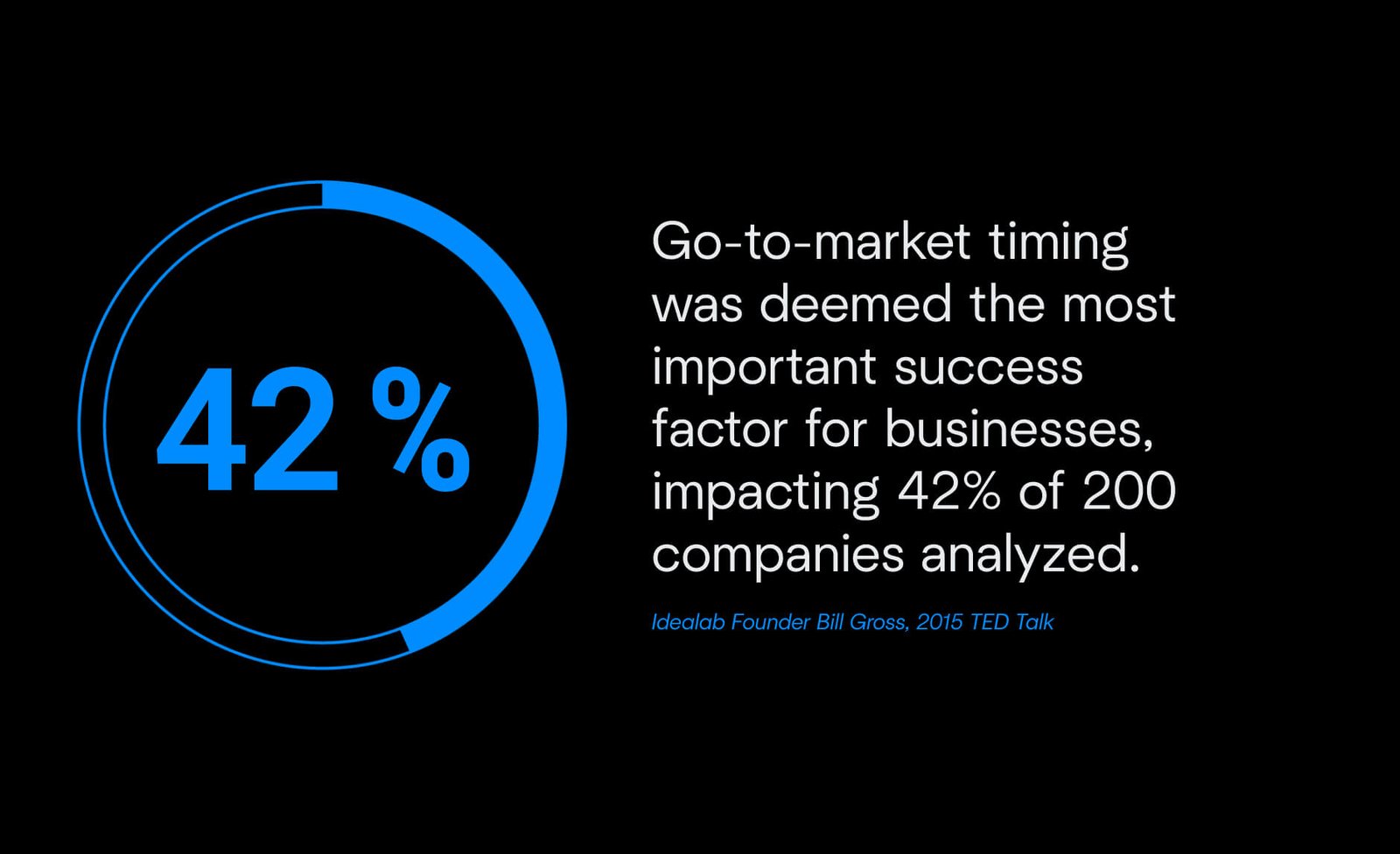
Market timing is one of the most underestimated factors in startup success. Even strong products, talented teams, and well-funded ventures can struggle if they launch before customers are ready—or after competitors dominate. Understanding market readiness, technology cycles, and consumer behavior can dramatically improve a startup’s chances of traction, funding, and long-term growth.
Why Market Timing Matters More Than Many Founders Expect
Entrepreneurship often celebrates bold ideas and visionary founders. But history shows that even excellent products can fail if they enter the market at the wrong time. Market timing—the alignment between a product and the readiness of its potential customers—can determine whether a startup scales quickly or struggles to survive.
Research from CB Insights, which analyzed hundreds of startup failures, consistently ranks “no market need” as the top reason startups fail, accounting for roughly 35–40% of cases. In many situations, the issue is not that the idea itself was bad. Instead, the market simply wasn’t ready.
Timing affects multiple dimensions of a startup’s trajectory:
- Customer adoption speed
- Investor interest
- Competitive pressure
- Infrastructure availability
- Economic cycles
Founders who understand these dynamics can position their companies more strategically, while those who overlook timing often discover that even strong execution cannot compensate for poor market conditions.
The Difference Between a Good Idea and the Right Moment
Many breakthrough products appear revolutionary, but in reality they succeed because the environment finally supports them.
Consider how similar ideas can succeed or fail depending on when they appear. In the late 1990s and early 2000s, several companies attempted online grocery delivery. Most failed due to limited internet adoption, weak logistics infrastructure, and consumer hesitation. Two decades later, the same concept became widely viable.
The difference was timing.
Several factors typically determine whether the market is ready:
- Technology maturity – Is the required infrastructure widely available?
- Consumer behavior – Are customers already comfortable with similar solutions?
- Economic conditions – Are buyers willing to spend money in this category?
- Regulation and policy – Are legal frameworks supportive or restrictive?
- Complementary products – Does the ecosystem enable your solution?
When these elements align, adoption accelerates. When they don’t, startups often spend years trying to convince customers to change behavior.
Early vs. Late: The Hidden Risks of Both
Entrepreneurs frequently assume that being first is always advantageous. In reality, both launching too early and too late carry serious risks.
When startups launch too early
Being ahead of the market can create major obstacles:
- Customers may not understand the problem yet.
- Infrastructure may be incomplete.
- Investors may struggle to see demand.
- Sales cycles become unusually long.
Many early innovators invest years educating the market before demand becomes meaningful.
When startups arrive too late
Entering after competitors dominate creates different challenges:
- Customer acquisition costs rise sharply.
- Brand loyalty favors incumbents.
- Investors prefer established leaders.
- Differentiation becomes difficult.
Timing, therefore, is less about speed and more about alignment with market readiness.
Signals That the Market Is Approaching Readiness
Experienced founders rarely rely on instinct alone when evaluating timing. Instead, they look for patterns that suggest the market is about to expand.
Several indicators often signal that conditions are improving:
- Rapid growth in related industries
- Falling technology costs
- Increasing media coverage of the problem
- Regulatory changes that enable innovation
- Large companies investing in the space
For example, the rapid expansion of cloud infrastructure dramatically lowered barriers for software startups in the 2010s. This shift enabled thousands of SaaS companies to launch products without building expensive data centers.
These macro-level signals often matter more than internal product features.
How Venture Capitalists Evaluate Market Timing
Investors pay close attention to timing because it directly influences growth potential. Venture capital firms typically evaluate startups through three interconnected lenses:
- Market size – How large could the opportunity become?
- Adoption speed – How quickly can the market grow?
- Category momentum – Are multiple companies emerging in the same space?
A rapidly expanding market often attracts more investment, which in turn accelerates startup growth.
Investors sometimes describe timing as the “invisible multiplier.” Even moderate execution in a fast-growing market can outperform excellent execution in a stagnant one.
Why Some “Overnight Successes” Are Actually Timing Wins
Startups that appear to grow suddenly often benefit from years of market evolution before their launch.
Many successful founders recognize a shift in behavior that is already underway. Instead of forcing a new trend, they ride the momentum of an existing one.
Common examples include:
- The shift toward remote work tools after broadband expansion
- Mobile-first apps emerging after smartphone adoption accelerated
- Online education platforms scaling after digital learning gained acceptance
In these cases, the startup’s success reflects both strong execution and favorable timing.
Practical Ways Founders Can Test Market Timing
Entrepreneurs cannot control market timing entirely, but they can evaluate it carefully before committing large resources.
1. Conduct demand-focused customer interviews
Instead of asking people whether they “like the idea,” founders should explore whether customers are already attempting to solve the problem.
Key questions include:
- How are you currently solving this issue?
- How much time or money does the problem cost you?
- What solutions have you already tried?
Strong demand often appears when customers actively search for alternatives.
2. Monitor behavioral changes, not just opinions
Consumer behavior is a more reliable indicator than survey responses. For example:
- Are customers already paying for partial solutions?
- Are search trends increasing around the problem?
- Are businesses allocating budget in this area?
Behavior signals readiness more clearly than interest.
3. Analyze infrastructure readiness
Many startups depend on technologies or services that must exist first.
Examples include:
- Payment systems
- High-speed internet
- Cloud computing
- Logistics networks
- Artificial intelligence tools
If these foundations are weak, the startup may struggle regardless of product quality.
4. Study adjacent market growth
Rapid growth in adjacent sectors often signals a coming opportunity.
For example:
- Rising smartphone usage enabled mobile app ecosystems.
- Growth in remote work created demand for digital collaboration tools.
- Increasing digital payments enabled fintech startups.
These secondary signals can indicate that a market is approaching maturity.
The Role of Patience in Market Timing
Some founders correctly identify a trend but launch slightly too early. In these situations, patience becomes a strategic asset.
Rather than forcing rapid scaling, successful founders often focus on:
- Building strong early communities
- Refining product-market fit
- Waiting for external conditions to improve
When the broader market finally accelerates, these startups are positioned to expand quickly.
This approach requires discipline, particularly when investors push for rapid growth.
Timing Mistakes Even Experienced Entrepreneurs Make
Even seasoned founders occasionally misjudge market readiness. Several common mistakes contribute to these errors.
Overestimating customer urgency
Founders sometimes assume that a technically impressive solution automatically creates demand. In reality, customers adopt new products when they solve urgent problems.
Ignoring adoption friction
Behavioral change is difficult. Products that require users to abandon familiar routines often struggle without strong incentives.
Confusing media attention with market readiness
A topic can receive extensive coverage without representing a large customer market.
Assuming early traction guarantees long-term demand
Initial excitement can fade if the underlying problem is not significant.
Understanding these risks helps founders maintain realistic expectations.
Frequently Asked Questions
1. What does market timing mean in startups?
Market timing refers to launching a product when customer demand, technology infrastructure, and economic conditions align to support rapid adoption.
2. Why is market timing important for startup success?
Even strong products struggle if customers are not ready to adopt them. Timing affects growth speed, investor interest, and competitive dynamics.
3. Can a startup succeed if it launches too early?
Yes, but it may require significant patience, education of the market, and financial resilience until demand develops.
4. How do founders evaluate whether the market is ready?
They analyze customer behavior, infrastructure readiness, industry trends, and demand indicators such as search activity and spending patterns.
5. Is being first to market always an advantage?
Not necessarily. Many successful startups are not the first in their category—they enter when the market is ready to scale.
6. What role do investors play in evaluating timing?
Investors often prioritize markets that are already growing quickly, since momentum can significantly accelerate startup expansion.
7. How can founders identify emerging trends?
Monitoring technology adoption, consumer behavior shifts, regulatory changes, and adjacent market growth can reveal emerging opportunities.
8. What industries are most sensitive to timing?
Technology, fintech, mobility, and consumer platforms often depend heavily on infrastructure and behavior shifts, making timing especially critical.
9. Can strong execution overcome poor timing?
Execution helps, but it rarely compensates for a market that is fundamentally unready.
10. Should founders delay launching if timing seems uncertain?
Sometimes. Testing ideas through small experiments can help validate demand before committing significant resources.
When Opportunity and Readiness Finally Meet
Startup success rarely comes from ideas alone. Instead, it emerges when innovation intersects with a market that is ready to embrace it.
Founders who carefully evaluate timing gain a significant strategic advantage. They recognize that customer readiness, infrastructure maturity, and industry momentum often matter as much as the product itself.
Rather than rushing to launch, thoughtful entrepreneurs pay close attention to the signals around them. When the moment is right, growth becomes far easier—and the startup’s efforts begin to compound.
Key Insights for Founders Watching Market Signals
- Market readiness often matters more than product originality
- Launching too early can be as risky as launching too late
- Infrastructure and technology cycles strongly influence adoption
- Behavioral change takes time and must align with real needs
- Monitoring adjacent industries helps identify emerging opportunities
- Investors prioritize markets with strong growth momentum
- Customer behavior reveals more than customer opinions