

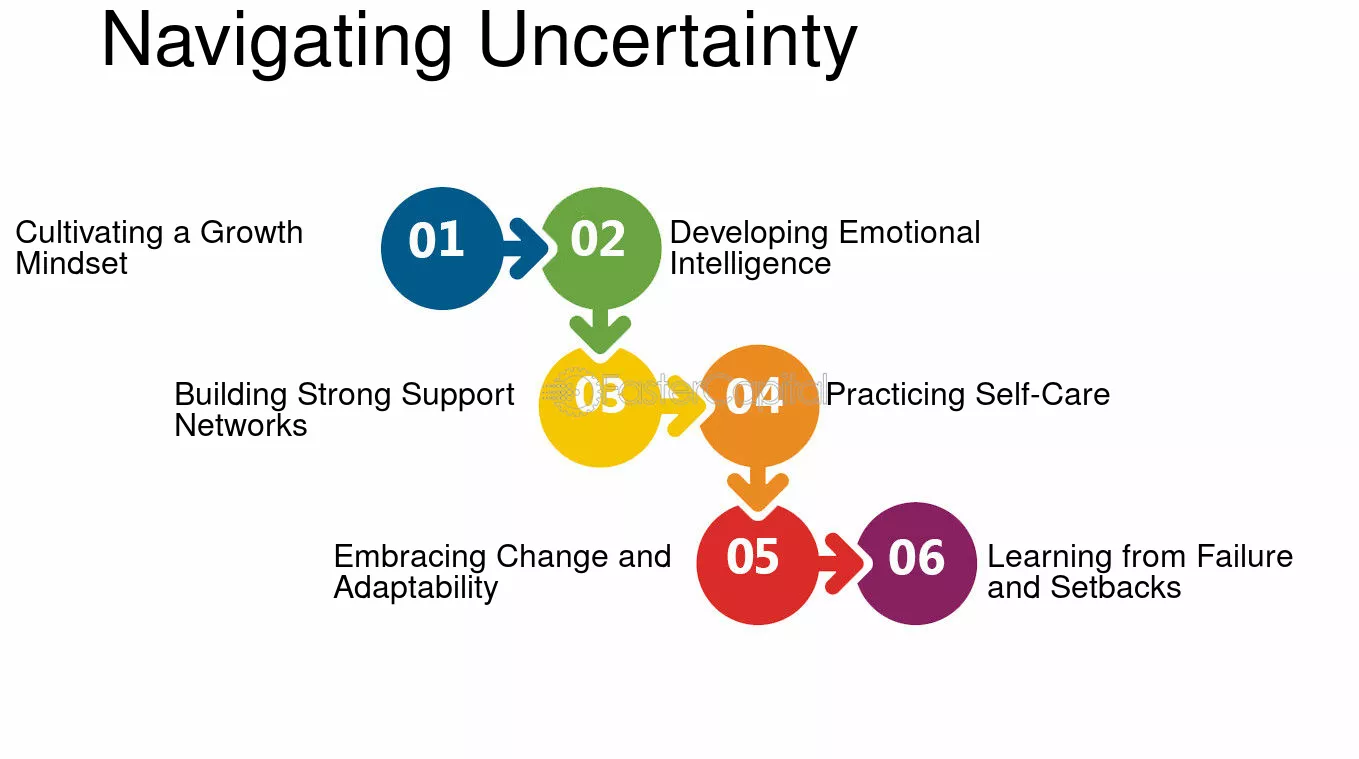
Uncertainty is a constant in entrepreneurship, yet some founders navigate it more effectively than others. Research and real-world experience show that resilient entrepreneurs rely on specific mental frameworks—adaptability, disciplined experimentation, long-term perspective, and emotional regulation. Understanding these mindset patterns can help new founders make better decisions, manage risk responsibly, and sustain progress even when markets, technology, or customer behavior change unexpectedly.
Why Uncertainty Is the Default Condition of Entrepreneurship
Entrepreneurship has always involved risk, but in today’s economy uncertainty is more visible and more frequent. Market conditions shift quickly, technology evolves rapidly, and consumer expectations change faster than many businesses anticipate.
For entrepreneurs, this means that predictability is limited. Even well-researched business plans must evolve as real-world conditions emerge.
Data from the U.S. Bureau of Labor Statistics illustrates this reality: roughly 20% of new businesses fail within their first year, and about half close within five years. These statistics are often cited as evidence of risk, but they also highlight something deeper—successful entrepreneurs rarely rely on certainty. Instead, they develop a mindset designed to operate effectively despite ambiguity.
Rather than attempting to eliminate uncertainty, experienced founders learn how to manage it.
The Core Mental Framework Behind Resilient Founders
Entrepreneurs who perform well in uncertain environments typically share several psychological patterns. These patterns are not personality traits people are born with—they are habits of thinking developed through experience.
At the core, resilient founders adopt what many researchers describe as adaptive decision-making. Instead of committing fully to rigid assumptions, they treat most early decisions as hypotheses that require testing.
This approach aligns closely with the principles described in The Lean Startup by Eric Ries, which encourages founders to run small experiments before committing large resources.
In practical terms, this mindset shifts entrepreneurship from a high-stakes gamble to a continuous learning process.
They Focus on Controllable Variables
One defining feature of experienced entrepreneurs is their focus on what they can control.
Markets fluctuate. Competitors emerge. Economic conditions shift. These factors are often outside a founder’s influence.
What entrepreneurs can control includes:
- how quickly they gather customer feedback
- how carefully they manage expenses
- how efficiently they test new ideas
- how clearly they communicate with customers
By concentrating attention on controllable variables, founders reduce emotional stress and maintain momentum even during uncertain periods.
For example, a software startup may not control overall market demand, but it can control product improvements, customer support quality, and marketing experiments.
These actions compound over time.
They Replace Predictions With Experiments
Traditional business planning often emphasizes forecasting. Entrepreneurs write projections for revenue, customer growth, and operating costs.
While forecasting can be useful, experienced founders understand its limitations.
Instead of relying exclusively on predictions, modern entrepreneurs often rely on structured experimentation.
Common experimentation practices include:
- launching limited product versions before full development
- testing multiple pricing models with small customer groups
- experimenting with different marketing channels
- running short-term pilot programs before expanding
Each experiment generates real-world data.
Over time, these small tests reduce uncertainty far more effectively than long-term predictions.
Emotional Stability Matters More Than Perfect Decisions
Entrepreneurship frequently involves setbacks. Product launches may underperform. Marketing campaigns may fail. Partnerships may fall apart.
What distinguishes resilient founders is not that they avoid these situations—but how they respond to them.
Research from the American Psychological Association shows that emotional regulation plays a significant role in decision-making under stress. Individuals who manage emotional reactions effectively are more likely to maintain strategic thinking.
Entrepreneurs often develop specific habits to maintain emotional stability:
- separating short-term setbacks from long-term goals
- maintaining structured routines during periods of uncertainty
- seeking external perspectives from advisors or mentors
- documenting decisions and reviewing outcomes objectively
These practices allow founders to maintain clarity even during difficult periods.
They Maintain a Long-Term Perspective
Another important mindset trait is long-term thinking.
In uncertain environments, it is easy to overreact to short-term fluctuations. Revenue dips, product delays, or competitive pressures can create urgency that leads to rushed decisions.
Experienced entrepreneurs instead anchor their decisions to long-term direction.
This perspective allows founders to ask more strategic questions:
- Does this challenge affect the long-term viability of the business?
- Is this a temporary market fluctuation?
- Are we solving a real customer problem that will remain relevant?
When entrepreneurs maintain a multi-year perspective, temporary volatility becomes easier to manage.
This long-term orientation is particularly important in industries involving technology or infrastructure, where meaningful results may take years to develop.
Learning Speed Becomes a Competitive Advantage
In uncertain markets, the fastest learner often gains the greatest advantage.
Successful entrepreneurs continuously collect information from customers, competitors, and internal data.
Key learning mechanisms include:
- direct customer interviews
- product usage analytics
- structured feedback systems
- industry trend monitoring
The goal is not simply to gather information but to interpret it effectively.
For example, if a startup launches a new feature that customers rarely use, resilient founders treat the outcome as useful data rather than failure. They adjust quickly and test alternative approaches.
This rapid feedback loop allows businesses to evolve faster than competitors.
They Build Systems That Reduce Cognitive Overload
Entrepreneurs make hundreds of decisions each week. Without structure, this constant decision-making can lead to fatigue and inconsistent judgment.
Experienced founders often build operational systems that reduce mental strain.
These systems may include:
- standardized hiring processes
- documented product development workflows
- automated financial tracking systems
- structured weekly planning routines
By reducing routine decision pressure, entrepreneurs free their attention for strategic thinking.
This approach is particularly valuable during periods of uncertainty, when clear thinking becomes even more important.
Support Networks Play a Critical Role
Despite the popular myth of the independent entrepreneur, successful founders rarely operate in isolation.
Advisors, peer founders, mentors, and industry experts often provide perspectives that help entrepreneurs navigate uncertainty.
Support networks commonly provide:
- strategic feedback on business decisions
- introductions to potential partners or investors
- emotional reassurance during difficult periods
- alternative viewpoints that challenge assumptions
Organizations such as the Kauffman Foundation have documented the importance of entrepreneurial ecosystems in helping founders succeed.
Entrepreneurs who actively cultivate these networks often make better decisions under uncertainty.
Frequently Asked Questions
Why is uncertainty so common in entrepreneurship?
Entrepreneurship involves building new solutions in markets that often lack clear precedents. Customer demand, competition, and technology can all change rapidly.
Can entrepreneurs ever eliminate uncertainty?
No. Uncertainty is inherent in business creation. However, entrepreneurs can reduce it by gathering information and testing ideas before making large commitments.
What mindset helps founders handle risk effectively?
A mindset focused on experimentation, adaptability, and long-term thinking helps entrepreneurs navigate risk more effectively.
How do entrepreneurs make decisions without perfect information?
They rely on small tests, customer feedback, and iterative improvements rather than waiting for complete certainty.
Do successful entrepreneurs have special personalities?
Research suggests that while traits like persistence help, many successful entrepreneurs develop their skills through experience and deliberate practice.
How important is emotional resilience for founders?
Very important. Entrepreneurship often involves setbacks, and emotional regulation helps maintain clear thinking during difficult periods.
What role do mentors play in entrepreneurship?
Mentors provide perspective, advice, and connections that can help founders avoid common mistakes.
How can new entrepreneurs develop a stronger mindset?
Practices such as structured experimentation, continuous learning, and reflective decision-making help build resilience over time.
Does data analysis help reduce uncertainty?
Yes. Customer analytics and market data allow entrepreneurs to make informed decisions rather than relying on assumptions.
Are uncertain environments always negative for startups?
Not necessarily. Uncertainty can create opportunities for innovative businesses that adapt faster than established competitors.
When Uncertainty Becomes a Strategic Advantage
While uncertainty often appears intimidating, experienced entrepreneurs eventually recognize that it can also create opportunity.
Large organizations tend to move slowly when markets shift. Startups, by contrast, often have the flexibility to experiment, pivot, and respond quickly.
Founders who develop the right mindset begin to view uncertainty not as an obstacle but as a competitive landscape where adaptability matters more than scale.
In this sense, uncertainty becomes less about risk and more about responsiveness. The entrepreneurs who succeed are not the ones who predict the future perfectly—they are the ones who learn and adjust faster than others.
Key Patterns Behind Entrepreneurial Resilience
- Resilient entrepreneurs focus on variables they can control
- They treat decisions as experiments rather than fixed commitments
- Emotional regulation helps maintain strategic thinking
- Long-term perspective prevents reactive decision-making
- Continuous learning provides a competitive advantage
- Operational systems reduce decision fatigue
- Strong networks provide guidance and perspective
- Data-driven feedback improves decision quality