

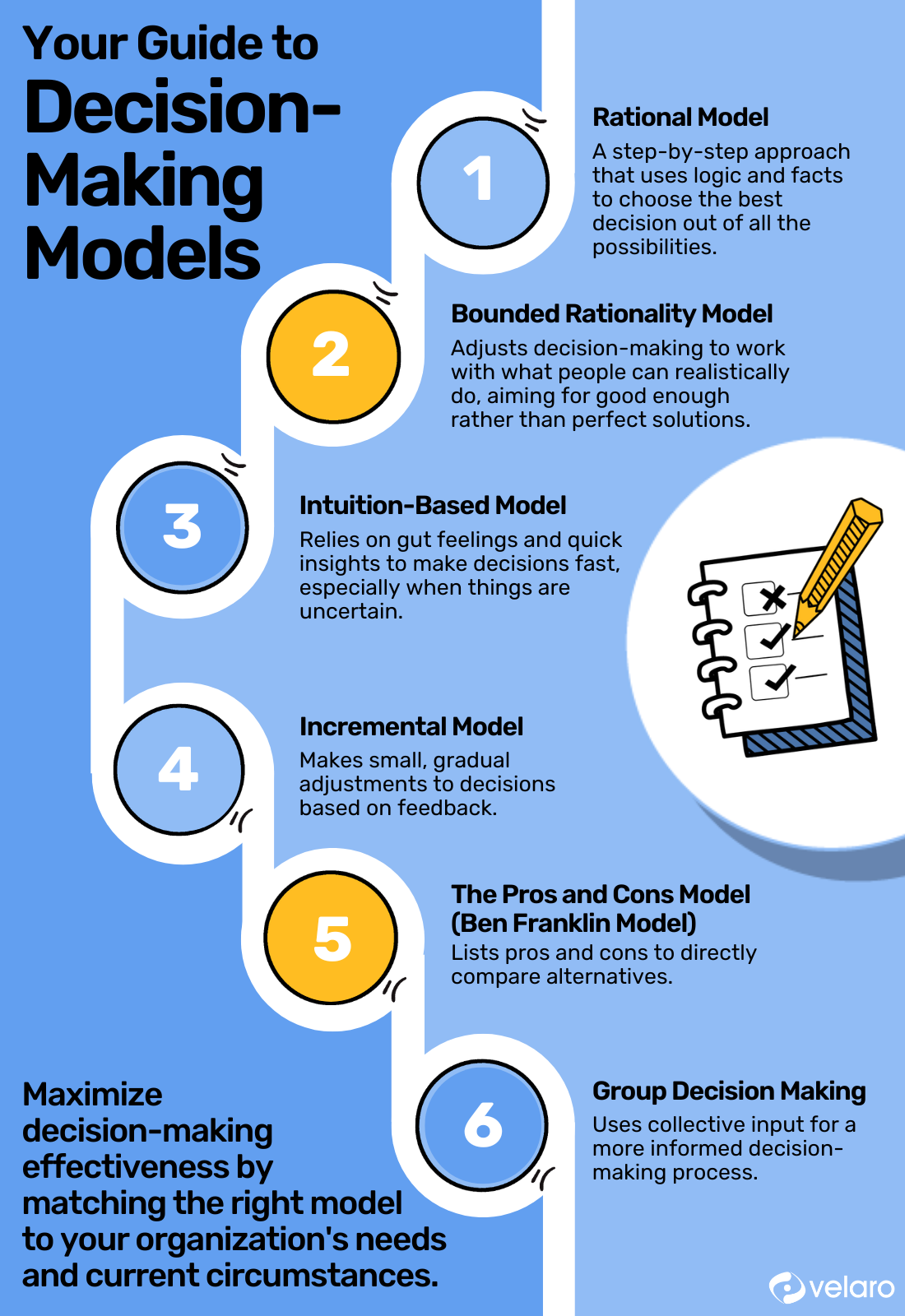
Successful entrepreneurs rarely rely on instinct alone when making business decisions. Instead, they apply structured frameworks that help evaluate risk, prioritize opportunities, and move quickly with limited information. This guide explores the practical decision-making models experienced founders use—from rapid validation methods to strategic prioritization systems—and explains how entrepreneurs apply them in real-world business situations.
Why Structured Decision-Making Matters in Entrepreneurship
Entrepreneurship requires constant decision-making. Founders must evaluate product features, hiring choices, pricing strategies, partnerships, funding opportunities, and market expansion—often under time pressure and with incomplete information.
Experienced entrepreneurs know that poor decisions rarely come from lack of effort. Instead, they often result from cognitive bias, incomplete data, or inconsistent evaluation criteria.
This is why seasoned founders rely on structured decision-making frameworks. These frameworks provide a repeatable process for evaluating options, clarifying priorities, and reducing emotional bias.
Research from leadership and management studies consistently shows that structured decision processes improve outcomes in complex environments. For example, many modern startup methodologies stem from the work of entrepreneur and educator Steve Blank, whose customer-development model emphasized evidence-based decision-making rather than assumptions.
For entrepreneurs operating in fast-moving markets, these frameworks provide three key benefits:
- Speed: Decisions can be made quickly without sacrificing quality.
- Consistency: Teams evaluate choices using the same criteria.
- Clarity: Stakeholders understand why a decision was made.
Experienced founders often combine several frameworks depending on the type of decision being made.
The OODA Loop: Making Decisions Quickly in Uncertain Environments
One of the most widely used frameworks among startup founders is the OODA Loop, originally developed for military strategy but highly applicable to business.
OODA stands for:
- Observe
- Orient
- Decide
- Act
The principle is simple: businesses that move through this loop faster than competitors gain a strategic advantage.
How Entrepreneurs Use It
Consider a startup launching a new software feature.
- Observe – Analyze user feedback, support tickets, and product analytics.
- Orient – Interpret the data and identify patterns or emerging problems.
- Decide – Choose whether to modify the feature, test a new version, or abandon it.
- Act – Deploy the change and gather new data.
This loop repeats continuously.
Startups that iterate quickly often outperform larger organizations because they can run this cycle faster.
The 10–10–10 Framework for High-Impact Decisions
Many founders face decisions that involve significant long-term consequences: hiring executives, entering new markets, or raising capital.
The 10–10–10 rule, popularized in leadership circles, helps clarify the future impact of a decision.
Entrepreneurs evaluate choices by asking three questions:
- How will I feel about this decision in 10 minutes?
- How will I feel about it in 10 months?
- How will I feel about it in 10 years?
The framework helps founders distinguish between short-term discomfort and long-term benefit.
Example
Imagine a founder deciding whether to pivot their startup.
- In 10 minutes, the decision may feel stressful or uncertain.
- In 10 months, it could position the company toward a stronger market opportunity.
- In 10 years, it may determine whether the company succeeded at all.
This time-horizon perspective often helps entrepreneurs make more strategic choices.
The ICE Scoring Model for Prioritizing Opportunities
Startups typically face dozens of potential initiatives:
- New features
- Marketing campaigns
- Partnership opportunities
- Product experiments
The ICE framework helps founders rank these options objectively.
ICE stands for:
- Impact – How much potential benefit could this initiative generate?
- Confidence – How confident are we that the hypothesis is correct?
- Ease – How simple or inexpensive is it to execute?
Each category receives a numerical score, and the combined total helps prioritize projects.
Example
A SaaS startup considering growth experiments might score options like this:
| Initiative | Impact | Confidence | Ease | Total |
|---|---|---|---|---|
| Referral program | 8 | 7 | 6 | 21 |
| New landing page | 6 | 8 | 9 | 23 |
| Influencer marketing | 7 | 5 | 4 | 16 |
This system prevents teams from focusing only on exciting ideas instead of practical ones.
The Expected Value Framework for Risk-Based Decisions
Entrepreneurs frequently make decisions involving uncertainty.
Should a founder:
- Enter a new market?
- Launch a risky product?
- Invest heavily in growth?
Experienced entrepreneurs often apply expected value thinking, a principle from economics and probability.
The formula is simple:
Expected Value = Probability of Outcome × Value of Outcome
Example
Imagine a startup considering a new product line:
- 30% chance of generating $10 million in revenue
- 70% chance of generating $0
Expected value:
0.3 × $10M = $3M expected value
If development costs $1M, the decision may still make sense.
This framework helps founders avoid overly conservative decisions that ignore potential upside.
The Opportunity Cost Lens
Experienced entrepreneurs constantly evaluate what they must give up to pursue a decision.
Opportunity cost is especially important for startups because their most limited resources are:
- Time
- Talent
- Capital
For example, if a startup team spends six months building a new feature, they cannot simultaneously focus on:
- improving customer retention
- expanding distribution
- optimizing pricing
Entrepreneurs therefore ask a simple but powerful question:
“What are we not doing because we are doing this?”
This perspective often reveals hidden trade-offs that affect growth.
The Market Opportunity Navigator
Strategic decisions about which market to pursue are among the most important choices entrepreneurs make.
The Market Opportunity Navigator helps founders systematically evaluate potential opportunities by analyzing three factors:
- Market attractiveness
- Fit with the startup’s capabilities
- Strategic growth potential
This framework was developed from research examining hundreds of startups and helps entrepreneurs identify the most promising markets for expansion.
Rather than chasing every opportunity, founders narrow their focus to the markets where they have the strongest competitive advantage.
The “Two-Way Door vs One-Way Door” Decision Rule
A popular concept in entrepreneurial leadership distinguishes between two types of decisions:
Two-Way Door Decisions
- Easily reversible
- Low long-term risk
- Suitable for quick experimentation
Examples:
- marketing campaigns
- landing page changes
- pricing experiments
One-Way Door Decisions
- Hard to reverse
- High strategic impact
- Require careful analysis
Examples:
- acquisitions
- major funding rounds
- entering regulated industries
Experienced entrepreneurs encourage teams to move quickly on reversible decisions while slowing down on irreversible ones.
This approach allows startups to maintain speed without creating unnecessary risk.
Collaborative Decision-Making in Startup Teams
Entrepreneurial decisions are rarely made alone. Founders rely on input from co-founders, advisors, investors, and team members.
Modern teams often use collaboration tools such as Miro to visualize ideas and strategy discussions in real time. The platform supports brainstorming, agile planning, and product design for distributed teams and is used by hundreds of thousands of organizations worldwide.
In practice, experienced founders combine structured frameworks with team collaboration techniques such as:
- rapid feedback sessions
- advisor consultations
- data-driven debate
- consensus voting systems
These processes help teams reach decisions faster while ensuring diverse perspectives are considered.
Balancing Data, Experience, and Intuition
Despite the value of frameworks, successful founders rarely rely on formulas alone.
Entrepreneurship still involves uncertainty, and many decisions require judgment that cannot be fully quantified.
Experienced entrepreneurs often combine three inputs:
- Data – metrics, market research, analytics
- Frameworks – structured evaluation methods
- Experience – pattern recognition from past decisions
Over time, founders develop the ability to recognize patterns that indicate whether a strategy is likely to succeed.
The frameworks described in this article do not replace intuition—they strengthen it by grounding decisions in evidence and structured thinking.
Frequently Asked Questions
What decision-making frameworks do entrepreneurs use most often?
Many founders rely on frameworks such as the OODA loop, ICE scoring model, expected value analysis, and opportunity cost evaluation. These frameworks help prioritize initiatives and manage uncertainty.
Why are frameworks useful for startup founders?
Frameworks reduce bias, improve consistency, and help teams evaluate options using the same criteria. They also allow founders to make faster decisions in complex environments.
How do entrepreneurs make decisions with limited data?
Experienced founders combine partial data with small experiments. Rapid testing allows them to validate assumptions before committing significant resources.
What is the most common mistake entrepreneurs make in decision-making?
One of the most common mistakes is delaying decisions too long while waiting for perfect information. In fast-moving markets, speed often matters more than certainty.
How do startup teams reach decisions quickly?
Many startups rely on structured discussions, scoring frameworks, and short feedback loops. Quick consultations with mentors or advisors are also common.
What role does intuition play in entrepreneurial decisions?
Intuition becomes more valuable as founders gain experience. Pattern recognition helps entrepreneurs interpret signals that may not yet appear in data.
How do entrepreneurs prioritize competing ideas?
Prioritization frameworks such as ICE scoring or opportunity-cost analysis help rank initiatives based on potential impact and feasibility.
Should founders rely on consensus or strong leadership decisions?
Both approaches are useful. Strategic decisions may require strong leadership, while operational decisions often benefit from collaborative input.
How can new entrepreneurs improve decision-making skills?
They can improve by studying common frameworks, documenting past decisions, reviewing outcomes, and seeking feedback from experienced mentors.
Decision-Making as a Founder’s Competitive Advantage
In early-stage companies, decision quality often determines survival.
Startups rarely fail because founders lack ideas. They fail because resources are allocated poorly or opportunities are evaluated incorrectly.
Experienced entrepreneurs treat decision-making as a core leadership skill, not just a daily responsibility.
By applying structured frameworks, founders can:
- identify promising opportunities faster
- allocate resources more effectively
- avoid common strategic mistakes
- build organizations that learn and adapt quickly
Over time, these habits compound into one of the most valuable advantages a startup can have.
Key Insights for Entrepreneurs
- Experienced founders rely on structured frameworks, not instinct alone.
- The OODA Loop helps startups move faster than competitors.
- ICE scoring allows teams to prioritize opportunities objectively.
- Expected value thinking helps evaluate risk and reward.
- Strategic decisions benefit from analyzing opportunity cost.
- Frameworks work best when combined with data, experience, and team collaboration.